
North Carolina car-accident attorney — for when the wreck wasn’t your fault.
A wreck rewrites everything in an afternoon: a totaled car, a body that won’t move right, a job that won’t wait, and an insurance company already building its case against you. I represent drivers, passengers, and motorcyclists across North and South Carolina — from a single rear-end on I-485 to a multi-vehicle pileup on I-77 — personally, from the first call to settlement or verdict. This page is what I wish more people read before they accept the first offer an adjuster slides across the table: how Carolina law actually treats these cases, where insurance companies aim their arguments, and what the strongest version of your claim looks like when it’s built right.
No fee unless we win · Personally handled by the attorney · Licensed in NC & SC
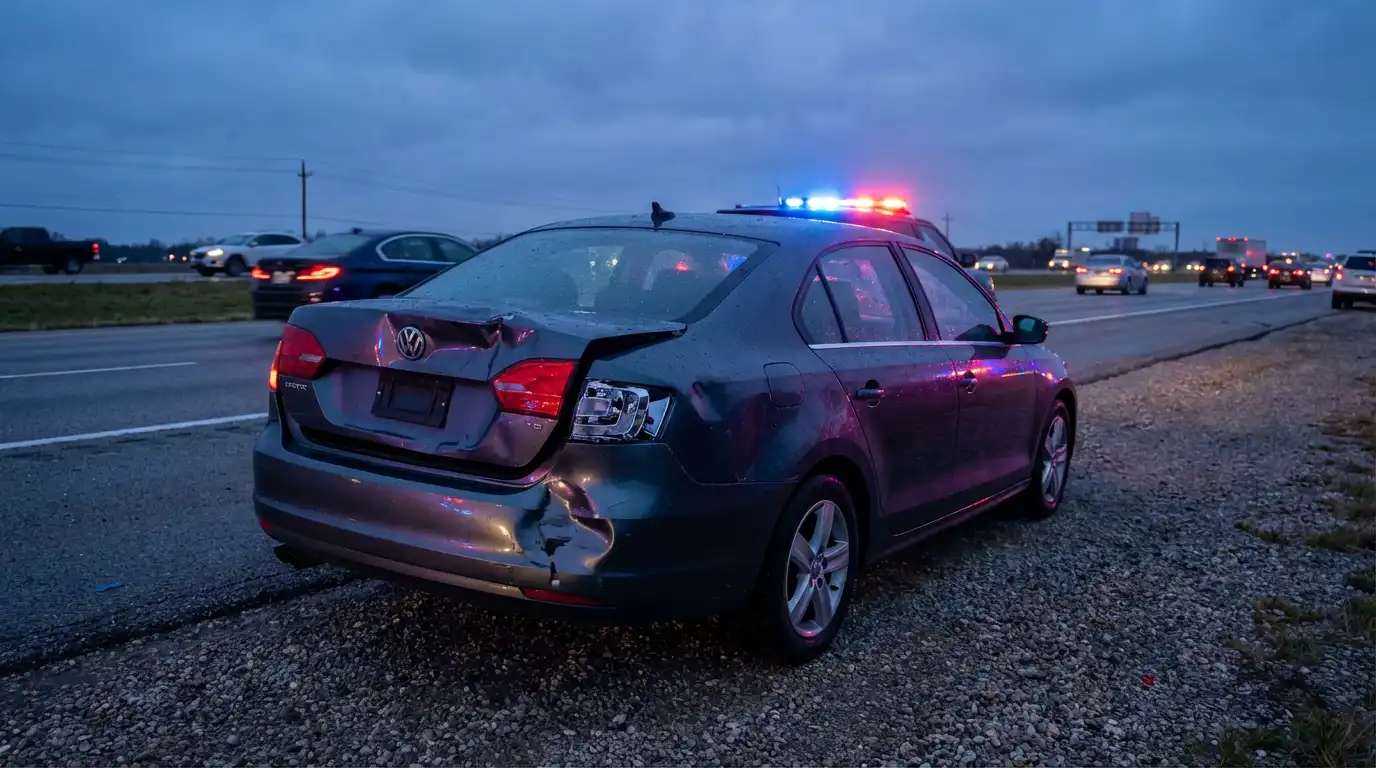

What a Carolina car-accident claim actually involves
A car-accident claim is, at bottom, an argument over three things: who was at fault, what injuries the wreck caused, and what those injuries are worth. The other driver’s insurance company will dispute every one of them if it can. Liability disputes show up as “he stopped short” or “you were following too closely” even in clear rear-end cases. Causation gets fought through medical records, looking for pre-existing conditions to blame. Damages get challenged through low offers and a property-damage figure that is treated like proof your injuries can’t be serious.
Most cases involve the same handful of facts: a rear-end collision at a stoplight on Independence Boulevard, a distracted driver who drifted on I-77, a left-turn cut-off at a Gastonia intersection, a failure to yield at a Charlotte merge, or a chain-reaction wreck on I-485 during rush hour. Whatever the mechanism, the legal work is the same shape — collect the evidence the insurance company will try to spin, document the medical care, calculate the full economic and non-economic damages, and present a demand the adjuster cannot reasonably ignore.
If a fair number doesn’t come back, the case is filed. Most cases still settle — but they settle for more when the insurer knows the lawyer on the other side will actually try the case if pushed. The difference between an average settlement and a strong one rarely comes down to one dramatic moment. It comes down to whether the file looks like a case that’s ready for trial when an adjuster opens it three months in.

Every crash type, every approach
Not every car wreck is the same case in legal terms. The crash type drives the proof problems, the likely defenses, and what the insurance company is going to try to spin.
Rear-end collisions. The classic case — and the one defense lawyers fight hardest. Liability looks obvious, so the insurer pivots to attacking your injuries (the MIST tactic, see below) or arguing you stopped abruptly. Property damage on rear-end cases is often modest, which insurers use to imply your soft-tissue injury must also be modest. Bad biomechanics, but useful narrative.
Intersection / T-bone wrecks. Liability is the main fight: who had the green light, who was turning, who failed to yield. Witness statements and traffic-camera footage matter enormously and disappear quickly. North Carolina’s contributory-negligence rule makes these cases especially dangerous if any sliver of fault attaches to the injured driver.
Head-on collisions. Usually catastrophic injuries and clear fault, but defendants often turn out to be uninsured or underinsured. UM/UIM coverage on your own policy becomes the critical recovery source.
Sideswipe and lane-change wrecks. Liability often turns on signals, lane position, and right-of-way. Defense argues the injured driver “didn’t move over” even when the other vehicle drifted.
Multi-vehicle pileups. The most evidence-intensive cases. Liability is apportioned among multiple drivers, and each defendant’s insurer points at the others. Identifying every available coverage source (multiple liability policies, each driver’s UM/UIM, an employer’s policy if any driver was on the job) is more than half the work.
Hit-and-run. Often the at-fault driver is never identified. UM coverage on your own policy is the recovery source. Prompt police reporting (within 24 hours typically required by the policy) and credible witness statements are essential.
Distracted-driving wrecks. Phone records, telematics data, and infotainment-system logs can prove that the at-fault driver was texting or scrolling at the moment of impact. Preservation letters need to go out within days, not weeks, because mobile carriers cycle records on short schedules.
How North Carolina contributory negligence actually plays out
North Carolina is one of only four states (along with Alabama, Maryland, and Virginia) that still applies pure contributory negligence. The rule is harsh: if a jury finds you 1% at fault for the wreck, the defense argues you recover nothing at all. Insurance companies in North Carolina know this and structure their entire claim-handling around it.
What “1% at fault” looks like in practice is rarely what people expect. The defense isn’t trying to prove you caused the wreck. They’re trying to find any thread — a glance at the radio, a slightly worn tire, a foot that didn’t reach the brake quite fast enough, a turn signal that came on a half-second late, a posted speed limit that you were arguably under but theoretically should have been further under given conditions — that lets them tell a jury you contributed to your own injury. Defense lawyers I worked with would draft a long list of these threads on every case, looking for the one or two that might stick.
The countermove is to anticipate every threadpiece argument before the case is filed. That means a careful crash-scene investigation, accurate downloading of the at-fault driver’s phone records and event-data recorder data, witness statements that are nailed down while memories are fresh, and a medical record that doesn’t leave openings for “pre-existing condition” or “degenerative changes” arguments. None of that work happens by accident.
There’s a related doctrine called the last clear chance that occasionally saves a case where the injured driver was technically negligent but the at-fault driver had the final opportunity to avoid the wreck. It’s narrow and fact-specific, but worth knowing about — some cases that look closed under contributory negligence reopen under last clear chance.
Practically, the lesson is simple: don’t accept the insurer’s theory of fault. The adjuster who tells you “you were partly to blame” is making a self-interested legal argument, not stating a fact. Whether you were actually at fault is a legal question that the insurance company doesn’t get to decide unilaterally.
How South Carolina cases differ
South Carolina uses modified comparative negligence with a 51% bar (sometimes called the “50% rule”): you can recover if your share of fault is 50% or less, with the award reduced by your percentage. So a $100,000 case where you’re found 20% at fault yields $80,000; the same case where you’re found 51% at fault yields nothing.
The math is more forgiving than NC’s, but the proof requirements don’t go away. The defense still tries to attribute as much fault to you as possible, pushing toward the 51% line. The investigation work is the same shape; the stakes around any single fact are just slightly less binary.
If your wreck happened in the I-77 corridor near the SC line, the question of where exactly the wreck occurred can be outcome-determinative. NC law applies to NC wrecks; SC law applies to SC wrecks. We pull GPS data, mile-marker locations, and the responding-agency’s report on every borderline case.
The Carolina claim timeline, step by step
Most car-accident cases follow a recognizable arc. Understanding it removes most of the anxiety that builds during the long stretches when nothing seems to be happening.
1. Investigation (weeks 1–6). Crash report, photographs, witness statements, vehicle inspection, preservation letters to mobile carriers and rideshare/trucking companies if applicable, downloading of the event-data recorder, opening of the property-damage claim with the at-fault carrier and (separately) your own carrier’s med-pay coverage.
2. Medical treatment to maximum medical improvement (months 1–9). You see your doctors; we don’t demand until your treatment has plateaued. Demanding too early leaves future medical costs on the table.
3. Records and bills assembly (1–3 months). Every provider, every visit, every bill. This is the unglamorous bulk of the work; it’s also where most cases either gain or lose value.
4. Demand and negotiation (1–3 months). The demand package goes to the at-fault carrier. Initial offer is usually low. Negotiation rounds follow.
5. Filing and litigation (if needed, 6–18 months). If a fair settlement isn’t offered, suit is filed. Discovery, depositions, expert reports, mediation. Most cases settle during litigation; some go to trial.
6. Resolution. Settlement check or jury verdict, payment of medical liens and case expenses, and the net to you. The fee is the contingency percentage of the recovery.
Common injuries — and why the medical record decides the case
The injuries that show up in Carolina car-accident cases follow predictable patterns by crash type. The legal work isn’t medical, but understanding what your treating doctors are documenting matters because the insurance company will read your records word-for-word looking for anything to use.
Whiplash and cervical strain. The most common injury in rear-end and intersection wrecks. Pain often shows up 24–72 hours after the wreck, not at the scene — which is why “refused medical transport” in the crash report becomes the centerpiece of every adjuster’s downplay. Modern imaging (MRI, not just X-ray) is often required to document soft-tissue injury.
Herniated and bulging discs. Cervical and lumbar disc injuries often need months of conservative treatment (PT, injections) before surgery is on the table. Insurers argue every disc finding is “degenerative” rather than traumatic. A treating physician who can specifically link the disc injury to the trauma is essential.
Traumatic brain injury (TBI). Concussions, especially mild TBI, are routinely missed at the scene and minimized by adjusters. Cognitive symptoms (memory, focus, irritability, sleep disruption) often outlast physical recovery. Neuropsychological testing documents what imaging can’t.
Fractures and orthopedic injuries. Broken bones look straightforward; the real cost is in surgical hardware, rehab, lost work during recovery, and the chance of long-term arthritis or chronic pain.
Soft-tissue injuries. The category insurers most aggressively undervalue. The defense reads “soft tissue” on a chart note as “not serious.” The reality is that soft-tissue injuries can be permanently disabling. Consistent treatment and clear physician documentation matter.

What to do after a Carolina wreck — a checklist
- Call 911. Get medical attention if anyone is hurt and request a police response. The crash report is the document every adjuster and lawyer will reference for the next two years.
- Photograph everything. Vehicle damage from multiple angles, the position of the cars before they’re moved, skid marks, debris, traffic signals, weather conditions, the other driver’s license plate.
- Get witness contact info. Names and phone numbers. Witnesses scatter within minutes; they don’t come back later.
- Don’t admit fault. Apologies and “I didn’t see them” become Exhibit A. Limit on-scene conversation to facts.
- See a doctor — even if you feel OK. Adrenaline masks pain at the scene; symptoms often appear 24–72 hours later. A same-day or next-day medical visit protects both your health and your case.
- Don’t give a recorded statement to the other driver’s insurer. Friendly questions, locked-in answers. Wait until you have counsel.
- Don’t post about the wreck on social media. Defense investigators screenshot everything.
- Call a lawyer before signing anything. Medical authorizations and property-damage releases sometimes include language that affects the injury claim. Read first; consult before signing.
What I learned defending insurance companies
I spent the early part of my career on the insurance-defense side — the lawyers paid by adjusters to keep payouts low. I sat in the strategy meetings. I read the internal claim-handling memos. The car-accident playbook I saw used over and over comes down to a handful of moves, and they’re predictable enough that you can plan against them.
The MIST tactic. “Minor Impact, Soft Tissue” is what defense calls a wreck with relatively light vehicle damage. Adjusters are trained to treat low property damage as proof your injuries can’t be serious. It’s a useful narrative for the insurer; it’s also bad biomechanics. A 10-mph impact can cause real cervical and lumbar injuries — bumper covers absorb the dollars, not the forces. Countering MIST is a documentation problem: complete, consistent medical care from the start, and an expert who can explain why the property-damage number isn’t a proxy for severity.
The recorded statement. The other driver’s adjuster will call within a few days asking for a recorded statement “just to get your side.” The questions are open-ended and friendly. They are also designed to lock you into answers about your speed, your visibility, your pain level, and your pre-existing conditions that the insurer will use months later to argue contributory negligence or apportion the injury to something else. There is almost never a reason to give one before you’ve talked to a lawyer.
The early lowball. Adjusters open low on purpose. They are betting on financial pressure — a totaled car, missed work, medical bills — to convince you to take less than the case is worth before you understand what your medical future actually looks like. The number that lands six weeks after a wreck is not the number a properly worked-up case is worth six months later.
The IME doctor. When liability is clear and damages are the fight, insurers send claimants to an “independent medical examination” with a doctor on the carrier’s short list. The reports are not independent — the doctors who keep getting referrals are the doctors who keep finding that the injuries are “degenerative,” “pre-existing,” or “resolved.” We know the panel, and we prepare the client for what to expect.
Social-media surveillance. Defense firms routinely run surveillance on injured plaintiffs — not just public social-media checks, but in serious cases actual sub-rosa video. A gym selfie three weeks after a wreck, a vacation photo at six months, a Facebook check-in at a 5K — any of those becomes Exhibit A. The advice is simple: assume everything you post is being read by an adjuster.
The billed-vs-paid argument. Insurers argue that the “value” of your medical care is whatever your health insurance actually paid, not what the providers billed. This dispute matters because medical specials are an anchor for the entire case value. NC law has evolved on this issue; current law leans toward letting the jury see the billed amount, but the carriers still push back. Knowing which version of the rule applies to your case is part of valuing it correctly.
Damages you can pursue
Past medical expenses
Everything from the ambulance ride and emergency-room visit to ongoing physical therapy, imaging, injections, and the surgical care you’ve already received.
Future medical care
Care you will still need: revision surgery, ongoing pain management, future imaging, durable medical equipment. Valued with help from your treating physicians and, when needed, a life-care planner.
Lost wages
Time out of work, lost overtime, lost benefits, used PTO that you would have kept otherwise.
Lost earning capacity
The harder, bigger number when an injury is permanent — the difference between what you were on track to earn and what your post-injury body can do.
Pain & suffering
Physical pain, the daily limitations, sleep disruption, and the loss of activities you used to enjoy — running, lifting your kids, sleeping through the night.
Property damage
Repair or replacement of the vehicle, diminished value (NC allows recovery for the value loss even after repair), rental, and personal property destroyed in the wreck.
Loss of consortium
Available to a spouse when the injury affects the marital relationship — intimacy, companionship, the practical division of household labor.
Punitive damages
Reserved for genuinely reckless conduct (drunk driving, street racing, fleeing the scene). Not available in routine negligence cases, but life-changing when they are.
Common mistakes that hurt your claim
- Giving a recorded statement to the other driver’s insurer. Friendly questions, locked-in answers. Wait until you have counsel.
- Posting about the wreck on social media. Defense investigators screenshot everything. A gym selfie three weeks in becomes Exhibit A on whether you’re hurt.
- Gaps in medical treatment. Even short gaps get spun as proof the injury wasn’t serious. Follow through on every appointment. If you have to miss, document why.
- Accepting the first offer. The first offer is an opening bid, not an honest valuation. It is almost always low.
- Treating property damage as proof of injury severity. Bumper covers absorb dollars, not bodies. They are not a 1:1 measure of what you suffered.
- Signing a medical authorization without reading it. Some authorizations grant access to your entire lifetime medical history, not just records relevant to the wreck. The defense uses unrelated history to dispute causation.
- Settling before maximum medical improvement. If you settle before your treatment plateaus, the cost of any future care comes out of your pocket, not the settlement.
- Forgetting your own UM/UIM coverage. When the at-fault driver is uninsured or underinsured, your own policy is the recovery source. Most people don’t know what limits they have until they need them.
- Talking to the adjuster without a lawyer reading what gets signed. Releases buried in routine paperwork can extinguish injury claims. Read everything; consult before signing.
- Waiting on the statute of limitations. Three years sounds like a lot until the file is two years and ten months old. The investigation is harder, witnesses scatter, and the settlement leverage drops.
Frequently asked questions
Do I have to sue, or can my case settle?
Most car-accident cases settle. The point of preparing every case as if it will be tried is to make settlement happen at a fair number. When insurers know the lawyer on the other side is willing to try the case, the math changes.
What if I think I was partly at fault?
In North Carolina, even 1% fault can defeat a claim — but that argument doesn’t end the conversation. Whether you were actually at fault is a legal question, and the insurer’s self-serving theory of fault isn’t the same as the legal reality. Don’t assume your case is dead because the adjuster tells you it is. In South Carolina, partial fault reduces but doesn’t bar recovery if you’re 50% or less at fault.
Do I have to call the police after a wreck?
Yes — both for safety and because the crash report is the document the entire case will reference. Without it, every fact becomes contested. If you didn’t call, it’s not fatal, but the case becomes harder to prove.
How long does a personal-injury case take?
It depends on your medical recovery. We typically don’t demand until you’ve reached maximum medical improvement, so the value of future care is known. From there, simple cases can resolve in months; cases that require litigation can run 12–24 months.
What if the other driver had no insurance or too little?
Your own policy may have uninsured (UM) or underinsured (UIM) motorist coverage that steps in. North Carolina’s minimum auto liability is only $30,000 per person / $60,000 per accident, which is often nowhere near enough on a serious injury. UM/UIM on your own policy — or on a household relative’s policy — is often the difference between a fair recovery and a partial one.
Do I have to deal with my own insurance company?
Some interaction is required: notifying them of the wreck, opening the property-damage and med-pay claims. The office takes over the substantive communication so you aren’t cross-examined by a friendly voice on the phone.
What does it cost to hire your office?
Nothing up front. Personal-injury representation is on contingency — the fee comes out of a recovery, not your pocket, and there is no fee at all if we don’t recover.
What does my own policy’s UM/UIM coverage actually cover?
Uninsured motorist (UM) covers you when the at-fault driver has no insurance, or in a hit-and-run. Underinsured motorist (UIM) covers the gap when the at-fault driver’s coverage is below your damages. Both apply even when you were on foot, on a bike, or a passenger in someone else’s car. Most clients are surprised to learn what coverage they had.
Will my insurance rates go up if I make a claim?
Filing a claim for a wreck that wasn’t your fault generally should not increase your premium under North Carolina’s “safe driver” insurance rules. If your carrier raises rates after a not-at-fault wreck, that itself can be challenged.
What if I was in someone else’s car when the wreck happened?
Passengers have full claims for their injuries. The available coverage usually includes the at-fault driver’s liability policy, the host driver’s policy (if their negligence contributed), and the passenger’s own UM/UIM. Multiple policies can stack.
Should I use med-pay coverage on my own policy?
Usually yes. Med-pay is a small but useful coverage that pays medical bills up to its limit regardless of fault. Using it does not waive your injury claim against the at-fault driver, though there may be subrogation to coordinate at settlement.
Should I see a doctor even if I feel OK?
Yes — same day or next day if possible. Adrenaline masks pain at the scene; cervical, lumbar, and concussion symptoms commonly appear 24–72 hours later. Early documentation matters both for your health and for any later claim.
Do I have to give a recorded statement to my own insurance company?
Your policy usually requires you to cooperate, which includes some sort of statement — but the form and timing are negotiable, and the statement to your own carrier is different from one to the at-fault carrier. We help structure both so you don’t volunteer information that doesn’t need to be given.
What if the at-fault driver fled the scene?
Hit-and-run wrecks typically trigger UM coverage on your own policy, even with no identifiable at-fault driver. Prompt reporting (typically within 24 hours of the wreck), credible witnesses, and physical evidence at the scene all become more important.
How is pain and suffering calculated?
There is no fixed formula. Insurers use multipliers based on medical specials, severity, treatment duration, and the impact on your life. The strength of the calculation depends heavily on the medical record, the photographs of injuries, statements from family members about how the injury changed your daily life, and your own credibility as a witness.
What if I had pre-existing conditions?
Pre-existing conditions don’t bar your claim. The legal rule (the “eggshell plaintiff” doctrine) is that the defendant takes you as they find you. If the wreck aggravated, accelerated, or worsened a pre-existing condition, the resulting damages are recoverable. The defense will fight this point hard; the medical record is where it gets won or lost.
Will my case go to trial?
Most don’t. The vast majority of Carolina car-accident cases settle — but they settle for more when the file is built as if it will be tried. If a fair settlement isn’t offered, we’re prepared to try the case. That posture changes the negotiation considerably.
Tell me what happened.
A free, confidential consultation. No fee unless we win.
Request a consultation 704-741-9399This page is general information about Carolina personal-injury practice and is not legal advice. Every case turns on its facts. Reading this page does not create an attorney–client relationship.