
Concord construction accident attorney — for Cabarrus County tradespeople hurt on the job.
Concord’s construction market has expanded rapidly — hospitality and retail near Concord Mills and the speedway, medical-system construction at Atrium Cabarrus, residential subdivision activity across Cabarrus County, and the warehousing/distribution build-out along the I-85 corridor. The injury caseload tracks the activity. Almost every serious Concord construction case has two tracks: workers’ comp through the NC Industrial Commission and a third-party negligence case in Cabarrus County Superior Court. I handle both, in parallel.
No fee unless we win · Personally handled by the attorney · Licensed in NC & SC
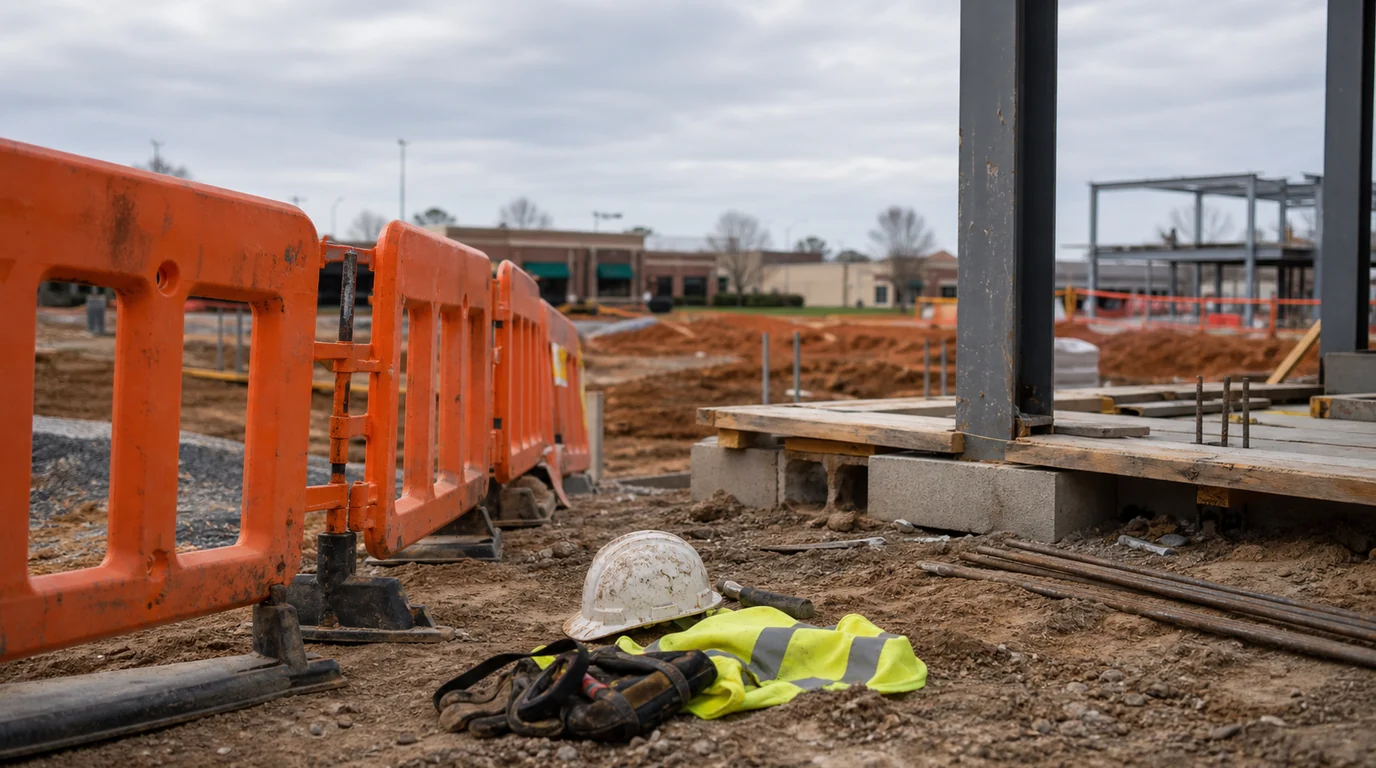

Where Concord construction injuries happen
The Concord Mills and speedway-corridor commercial market drives a recurring set of construction-injury cases: hotel construction, restaurant build-outs, retail expansion, parking-deck construction, and event-venue improvements. The injury fact patterns are similar to other commercial-construction markets — falls, struck-by, electrical, mechanical-trade injuries — with the added complication that some projects coordinate around active venue and shopping operations.
Atrium Health Cabarrus expansion construction produces medical-construction injury cases with the same patterns Charlotte sees at Atrium and Novant projects: MEP-trade injuries, controlled-demolition incidents, and the crew-alongside-active-hospital-operations issue. Insurance coverage layers are deep on medical-system projects, which materially expands the recovery ceiling.
The I-85 logistics corridor through Cabarrus County — warehouse, distribution, and fulfillment-center construction — produces a steady stream of struck-by-vehicle, equipment-failure, and trench-collapse cases. Multi-contractor coordination is heavy on these projects; identifying every potential third-party defendant is core early work.
The residential subdivision build-out across Cabarrus County, particularly in the new growth corridors south and west of Concord, produces high-volume injuries in framing, roofing, mechanical-trades, and excavation. The sub-sub coverage-gap pattern that runs through Gaston and Mecklenburg residential markets applies in Cabarrus equally.
Downtown Concord historic-district renovations and the steady governmental construction activity (county facilities, municipal projects) round out the caseload.
Medical care and the Cabarrus County workers’-comp/court overlap
Severe Concord construction injuries route to Atrium Health Cabarrus for initial trauma care, with transfer to Atrium Health Carolinas Medical Center in Charlotte for the most severe cases. The transfer pathway is well-documented in the records system. Trauma, orthopedic, and rehabilitation records are central to both the comp claim and the third-party case.
Comp cases run through the NC Industrial Commission. Civil third-party cases file in Cabarrus County Superior Court in Concord. The two tracks run in parallel; the comp carrier asserts a lien on the third-party recovery that is negotiated as part of the resolution.
How North Carolina law shapes a Concord construction case
NC’s Workers’ Compensation Act applies. Concord cases are heavy in multi-contractor coordination issues because of the hospitality and warehouse-construction defendant universe — GC, multiple specialty subs, equipment manufacturers, owners, and sometimes anchor-tenant defendants all show up in the same case. NC’s framework allows third-party claims against each non-employer party whose conduct contributed; identifying the right defendants is the work.
Medical-system construction cases benefit from high CGL coverage layers typical of hospital-system projects. Excess and umbrella coverage on these projects materially expands the recovery ceiling when liability against owner or GC is established.
Contributory negligence applies in the third-party case. The carrier’s preferred framing in Cabarrus cases often involves PPE compliance, training records, and fatigue / shift-length arguments tied to schedule pressure.
Insider perspective on Concord cases
The Cabarrus County defense playbook in hospitality and warehouse-construction cases has one feature worth knowing: defense counsel sometimes argues that the GC’s “general supervision” role did not amount to control over safety, hoping to dismiss the GC out of the third-party case before discovery. The response is to map the contract documents, the safety-plan responsibility, the daily superintendent role, and the actual day-to-day site control — usually enough to defeat the early dispositive motion and keep the GC in the case.
Concord — common questions
I was hurt on a Concord hotel or Concord Mills retail construction site. Multiple contractors. Who’s the defendant?
Often several. NC law allows third-party claims against every non-employer party whose conduct contributed — GC, specialty subs, equipment manufacturers, owners, and sometimes anchor-tenant defendants. Identifying every potential defendant in the first 30–60 days affects the recovery ceiling materially.
Atrium Cabarrus construction injury. How does the hospital’s involvement affect liability?
Hospital ownership of the project sometimes adds an owner-liability theory in addition to GC and sub-sub liability. Medical-system projects typically have deeper CGL and excess coverage layers than standard commercial projects, which expands the recovery ceiling when liability is established.
I’m a sub-sub on a Cabarrus residential build with no comp coverage. What happens?
NC’s “statutory employer” doctrine can pull the GC into the comp picture when the direct employer lacked coverage. The threshold question is the GC’s actual comp status and the contract structure. We evaluate the comp-coverage question first in every residential intake.
For the full Carolina legal framework
This page covers the local context of construction-site injuries in Concord and Cabarrus County. For the comprehensive Carolina construction-injury framework, OSHA standards, NC Industrial Commission procedure, and the full 15 FAQs — Carolina Construction Accident Attorney.
Construction-injury cases in nearby Carolina cities
Tell me what happened in Concord.
A free, confidential consultation. No fee unless we win.
Request a consultation 704-741-9399General information about Carolina personal-injury practice; not legal advice. Every case turns on its facts. Reading this page does not create an attorney–client relationship.