
Charlotte construction accident attorney — for Mecklenburg County tradespeople hurt on the job.
Charlotte is the busiest construction market in the Carolinas, and it shows in the injury caseload. Uptown high-rise builds, the Atrium and Novant medical-system expansions, the LYNX Blue Line and Silver Line extensions, the warehouse and logistics build-out along I-485, and the relentless residential subdivision activity from Steele Creek to Huntersville all generate construction-injury work. Almost every serious Charlotte construction case is two cases at once: workers’ compensation through the employer’s comp carrier, plus a separate third-party negligence claim against the general contractor, sub-sub, equipment manufacturer, or operator whose conduct contributed. I handle both tracks, in parallel, personally.
No fee unless we win · Personally handled by the attorney · Licensed in NC & SC
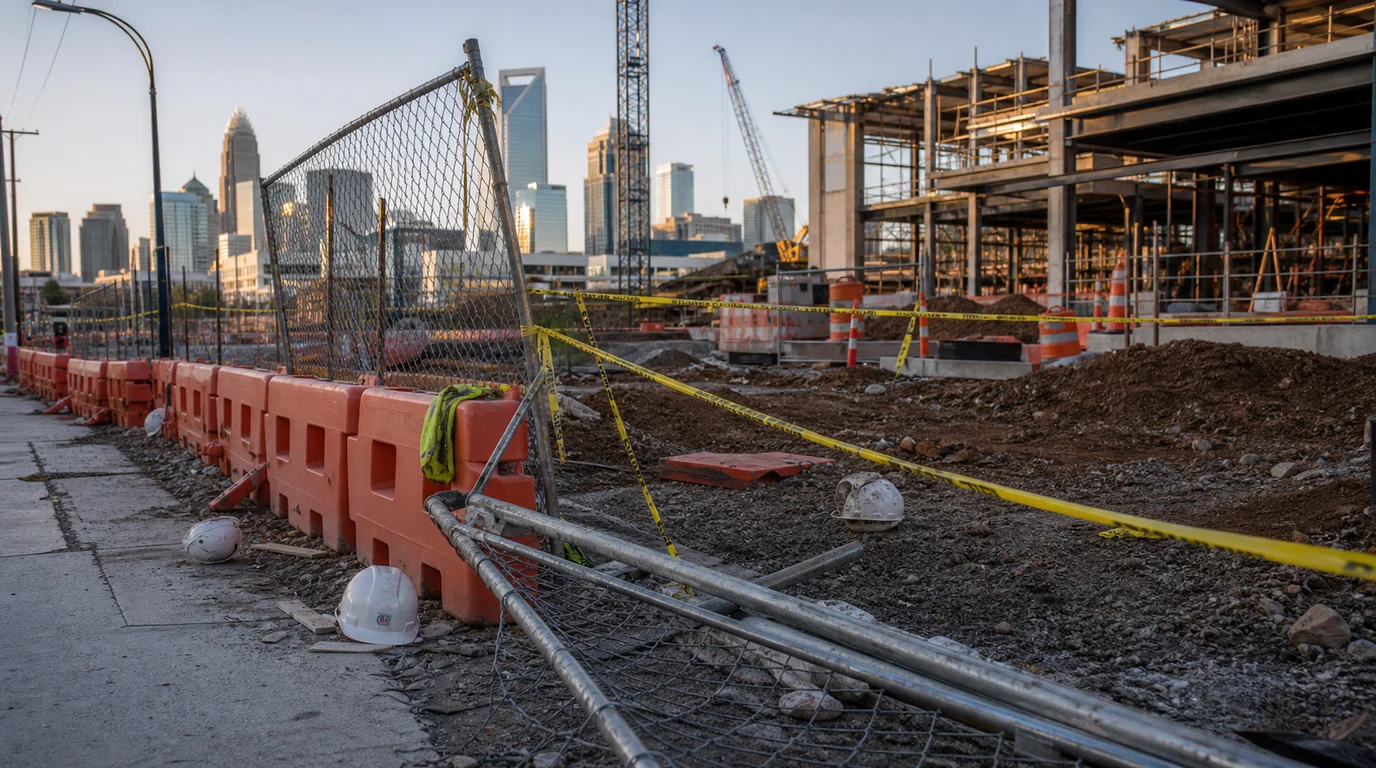

Where Charlotte construction injuries happen
Charlotte construction injuries cluster predictably by project type. Uptown high-rise construction — the active towers and the next wave already broken ground — produces the most serious fall-from-height and struck-by cases. The injury fact patterns track national construction-fatality data closely: unprotected leading edges, scaffolding failures, falling tools and materials, and crane and lift incidents.
The Atrium and Novant medical-system expansions (CMC tower work, Atrium Pineville, the LakePoint and Ballantyne campuses, Novant Presbyterian and Mint Hill builds) produce a different injury mix: mechanical-electrical-plumbing trade injuries, controlled-demolition incidents, and the recurring issue of construction crews working alongside active hospital operations. Insurance coverage on these projects is usually high — multiple layers of CGL and excess — which materially expands the recovery ceiling in third-party cases.
The LYNX Blue Line extension, Silver Line work, and the broader CATS corridor build-out generate transit-construction injuries with their own regulatory overlay (federal-funded projects with their own safety requirements). Cases here often involve multiple contractor layers and require careful identification of the right defendant tier.
The I-485 / I-77 / I-85 logistics corridor build-out — warehouse, distribution, and fulfillment-center construction — produces a steady stream of struck-by-vehicle, equipment-failure, and trench-collapse cases. The general-contractor and developer footprints in this corridor are concentrated; the same names recur as defendants.
Residential subdivision construction across Steele Creek, Ballantyne, University City, Huntersville, and Mint Hill produces a high volume of injuries in framing, roofing, mechanical-trades, and excavation work — often involving sub-sub crews whose comp coverage is the threshold question.
The I-485 outer ring logistics build-out deserves specific attention because it has become one of the most active construction zones in the Carolinas over the past several years and shows no sign of slowing. The fulfilment-center, cold-storage, and last-mile distribution facility construction concentrated between the Steele Creek/Carowinds Boulevard interchange and the Monroe Road / Mint Hill corridor involves unusually large footprints, tight delivery schedules, and GC contracts that often push safety-program responsibility down to sub-contractors with limited safety infrastructure. Concrete tilt-up, structural-steel erection, and heavy-equipment-staging incidents are the dominant severe-injury categories in this zone. Because the same national GC and developer names recur across multiple projects, their internal safety records — prior incidents, OSHA interaction history, safety-director turnover — are often discoverable in a way that single-project cases don’t allow.
The uptown stadium-district and South End development corridor — particularly the mixed-use towers and hotel/hospitality construction adjacent to the Spectrum Center and around the Bank of America Stadium footprint — produces high-rise construction injuries with significant insurance stacks. Projects in this zone routinely carry CGL limits in excess of $10 million plus excess layers; the recovery ceiling in a third-party case can be materially higher than in comparable suburban construction. The same projects also produce street-level pedestrian/bystander construction injuries — falling material, work-zone vehicle incidents — which are straight negligence cases rather than comp-overlap situations.
Medical care and the Mecklenburg County workers’-comp/court overlap
Severe Charlotte construction injuries route to Atrium Health Carolinas Medical Center in Dilworth — the only Level I trauma center in the region. Orthopedic trauma, spine injuries, and traumatic brain injuries are common in fall and struck-by cases. Plastic-surgery and reconstructive specialists in SouthPark and Ballantyne pick up scarring and complex-wound follow-up. The records are dense, well-organized, and central to both the comp claim and the third-party case.
Workers’-comp cases run through the NC Industrial Commission with its own filings, hearings, and procedures. The civil third-party case files in Mecklenburg County Superior Court when the controversy exceeds $25,000 (most do). The two tracks run in parallel until resolution; the comp carrier asserts a lien on third-party recoveries that has to be negotiated as part of the resolution.
How North Carolina law shapes a Charlotte construction case
NC’s Workers’ Compensation Act under N.C.G.S. Chapter 97 is the exclusive remedy against the worker’s direct employer in most cases — even if the employer’s conduct was negligent. The comp claim covers medical care, partial wage replacement (66 2/3% subject to caps), and rated permanent-impairment benefits. It does not cover pain and suffering, full lost wages, or future earning capacity. Those damages live in the third-party negligence case against the general contractor, sub-sub, equipment manufacturer, vehicle operator, or other non-employer whose conduct contributed.
Charlotte construction third-party cases are unusually rich in evidence because of the OSHA citation pathway and the NC Department of Labor Occupational Safety and Health Division investigation files. Citations and inspection reports support negligence-per-se claims and frequently expose multi-contractor liability that the family wouldn’t see otherwise.
NC’s contributory-negligence rule applies in the third-party case (not the comp claim). The carrier will attempt to pin fault on the injured worker — failure to use PPE, ignoring instructions, working too fast — and that framing has to be anticipated and dismantled. Last clear chance and statutory-violation arguments are common workarounds.
Insider perspective on Charlotte cases
The defense playbook in Charlotte third-party construction cases has three predictable moves. First, the early comp settlement push: the comp carrier offers a clinical settlement before the third-party case is investigated, hoping to extinguish the comp claim cleanly without exposure to lien negotiations later. Second, the multi-contractor finger-pointing: the GC blames the sub, the sub blames the supplier, the supplier blames the equipment manufacturer. The plaintiff side has to map every layer and pursue every credible defendant before the limitation period closes. Third, the OSHA timing game: defense counsel sometimes waits for the OSHA file to close (months after the incident) before producing meaningful discovery, hoping the plaintiff side settles before the citations and inspection notes are visible. The response is to request the OSHA file directly through the NC Department of Labor records process and not wait for defense production.
Charlotte — common questions
I was hurt on a Charlotte job site — do I file workers’ comp, or sue, or both?
In most cases, both, on separate tracks. Workers’ comp pays medical care and partial wages through your employer’s comp carrier; you can’t generally sue your direct employer. A separate third-party negligence claim against the GC, sub-sub, equipment manufacturer, or other non-employer whose conduct contributed covers pain and suffering, full lost wages, and future earning capacity. The two are coordinated; the comp carrier asserts a lien on the third-party recovery.
What about the general contractor — can I sue them if they aren’t my employer?
Often yes, depending on how the GC controlled site safety and what their contractual responsibility was. NC law lets workers sue non-employer parties whose negligence contributed. GCs, owners, and other subs are routine third-party defendants in Charlotte construction cases.
OSHA cited the contractor after my injury — does that help my case?
Usually yes. NC Labor Commissioner citations and inspection reports support negligence-per-se claims in NC construction cases. The citation is admissible in the civil case (with appropriate foundation) and frequently exposes safety-program failures that the employer would otherwise have kept quiet. We obtain the OSHA file directly rather than waiting for defense production.
What specific defect categories come up most often in Charlotte third-party construction cases?
In Charlotte’s current construction environment, the most common third-party defect theories are: (1) fall-protection failures — unprotected leading edges, scaffold without adequate guardrails, roof work without tie-off — where the GC had contractual safety-program authority; (2) struck-by equipment incidents where the equipment operator was under a different sub’s supervision; (3) equipment-manufacturer claims for missing or bypassed machine-guarding; and (4) trench and excavation collapses where OSHA-required shoring specifications were not followed. The I-485 logistics-corridor build-out has added structural-steel erection and tilt-up panel injuries to that list in recent years.
How do the workers’-comp and third-party timelines coordinate when both tracks are running?
Comp runs faster and resolves first in most cases. Comp benefits begin immediately; a structured settlement or final award typically comes within 12–18 months. The third-party civil case moves on its own Mecklenburg County docket timeline — usually 18–30 months from filing. The comp carrier’s lien is negotiated and resolved at the same time as the third-party settlement or judgment. Because the comp carrier has a lien on the third-party proceeds, all three parties — you, the comp carrier, and the third-party defendants — have to reach agreement simultaneously. That coordination is part of the case-management work, not an afterthought.
For the full Carolina legal framework
This page covers the local context of construction-site injuries in Charlotte and across Mecklenburg County. For the comprehensive Carolina construction-injury framework — the workers’-compensation track, third-party negligence claims, OSHA standards, NC Labor Commissioner records, and the full 15 FAQs — Carolina Construction Accident Attorney.
Construction-injury cases in nearby Carolina cities
Tell me what happened in Charlotte.
A free, confidential consultation. No fee unless we win.
Request a consultation 704-741-9399General information about Carolina personal-injury practice; not legal advice. Every case turns on its facts. Reading this page does not create an attorney–client relationship.