
Rock Hill construction accident attorney — for York County tradespeople hurt on the job.
Rock Hill construction-injury cases run under South Carolina law, not North Carolina law — and the differences matter. SC’s Workers’ Compensation Act has its own structure, benefit calculations, and procedure (SC Workers’ Compensation Commission rather than NC Industrial Commission). And the third-party negligence track runs under SC’s modified comparative-negligence rule, not NC’s contributory-negligence trap — which means cases that would be barred entirely in Charlotte often recover meaningfully in Rock Hill.
No fee unless we win · Personally handled by the attorney · Licensed in NC & SC
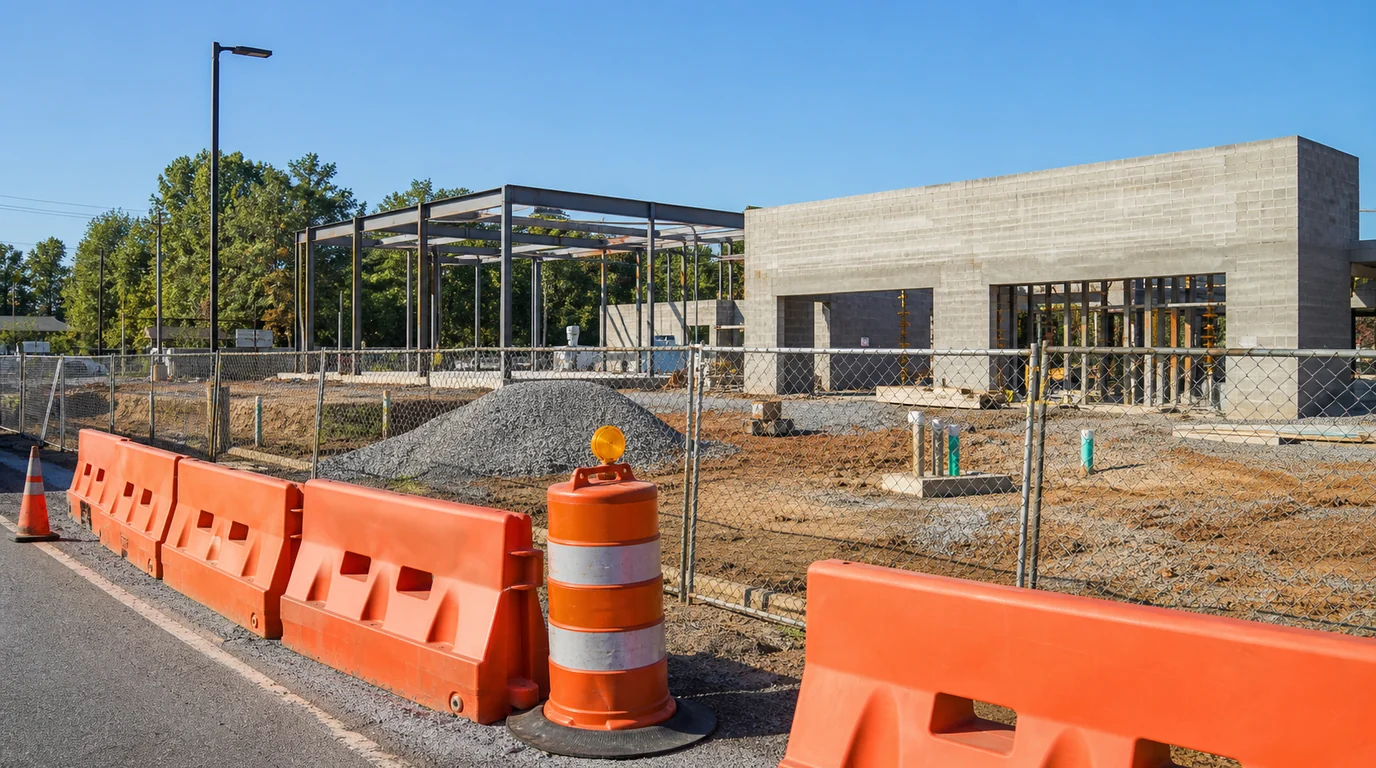

Where Rock Hill construction injuries happen
Rock Hill’s construction market has expanded along with the broader York County growth. The Cherry Road / Anderson Road commercial corridor drives a recurring stream of commercial build-out cases. The Knowledge Park downtown development and the broader downtown revitalization produce adaptive-reuse and new-construction injury cases. The I-77 logistics corridor through York County produces warehouse and distribution-center construction injuries.
The Winthrop University area and the broader Rock Hill institutional footprint generate ongoing institutional and academic-facility construction. Multi-contractor projects with deep CGL coverage layers typical of large institutional builds expand the recovery ceiling in third-party cases.
Residential subdivision construction across York County — Newport, Lesslie, and the established Rock Hill neighborhoods — produces the high-volume injury caseload in framing, roofing, mechanical-trades, and excavation. SC’s comparative-negligence rule changes how worker-conduct defenses are evaluated in these cases.
Medical-construction work at Piedmont Medical Center and its expanding outpatient footprint adds a hospital-system-construction case category similar to what Atrium and Novant projects generate on the NC side.
Medical care and the York County workers’-comp/court overlap
Severe Rock Hill construction injuries route to Piedmont Medical Center for initial trauma care, with transfer to Atrium Health Carolinas Medical Center in Charlotte or MUSC in Charleston for the most severe cases. The transfer decision depends on case profile and EMS judgment. Trauma, orthopedic, and rehabilitation records are central to both the comp claim and the third-party case.
Comp cases run through the SC Workers’ Compensation Commission; civil third-party cases file in York County Court of Common Pleas. The two tracks run in parallel; the comp carrier asserts a lien on the third-party recovery under SC law (the framework differs from NC’s in particulars worth understanding).
How South Carolina law shapes a Rock Hill construction case
SC’s Workers’ Compensation Act (S.C. Code Title 42) applies. Benefit structures, statute of limitations, and dispute procedures differ from NC’s in material ways. The third-party negligence framework runs under SC’s modified comparative-negligence rule under the 51% bar: as long as the worker’s fault share is 50% or less, recovery is permitted with damages reduced by the fault percentage. Cases that would be barred entirely in NC on contributory negligence routinely recover in SC.
SC’s product-liability framework for equipment-defect cases also differs from NC’s in some particulars; the recovery ceiling on machinery-defect cases is similarly high to NC and often the principal recovery vehicle when equipment failure contributed.
SC’s workers’-comp lien framework on third-party recoveries differs from NC’s. The carrier’s lien is recoverable but the negotiation framework, the apportionment between past and future medicals, and the attorney-fee credit calculation all run on SC rules. Getting this right matters at resolution.
Insider perspective on Rock Hill cases
The recurring complication in Rock Hill construction cases is the cross-border practice gap. Defense counsel sometimes brings NC-style framing into SC cases — particularly contributory-negligence reflexes that don’t apply under SC comparative law. Holding the case in SC procedure and SC substantive law is part of the strategic work, particularly at jury-charge time. The doctrinal advantages SC law confers only hold if the case is actually litigated under SC law.
Rock Hill — common questions
I was told my Rock Hill construction case is barred because I wasn’t wearing PPE. True?
Almost certainly not. SC’s comparative-negligence rule means PPE non-use reduces recovery by your fault share — it doesn’t bar the case unless your fault was 51% or more. A near-identical case in NC might be barred entirely on contributory negligence; in SC it usually proceeds with a reduced but meaningful recovery.
My employer is in NC but my injury happened on a Rock Hill site. Which state’s comp law applies?
Usually SC because the injury occurred in SC, but the analysis can be nuanced when the employment relationship is NC-based and the work crosses state lines. Both states’ comp laws have to be evaluated. The third-party case files in SC because the injury occurred in SC.
Equipment-manufacturer case in SC — different than NC?
SC’s product-liability framework has its own particulars, but the recovery ceiling is comparable and the procedural requirements are workable. We evaluate manufacturer liability in every machinery-injury intake regardless of state.
For the full Carolina legal framework
This page covers the local context of construction-site injuries in Rock Hill and across York County, South Carolina. SC’s workers’-comp law and SC’s comparative-negligence rule both differ from NC’s. For the comprehensive Carolina construction-injury framework and the full 15 FAQs — Carolina Construction Accident Attorney.
Construction-injury cases in nearby Carolina cities
Tell me what happened in Rock Hill.
A free, confidential consultation. No fee unless we win.
Request a consultation 704-741-9399General information about Carolina personal-injury practice; not legal advice. Every case turns on its facts. Reading this page does not create an attorney–client relationship.