
Charlotte rear-end accident attorney — for Mecklenburg County drivers hit from behind.
If you were rear-ended on I-77 through Uptown, on the I-485 outer loop, or in the stop-and-go on Independence Boulevard, you already know two things: Charlotte traffic is unforgiving, and the at-fault driver’s insurance company is going to fight you the moment you file. I represent rear-end victims across Mecklenburg County personally — a former insurance-defense attorney now working for injured drivers and passengers instead of against them. This page covers where Charlotte rear-end wrecks actually happen, how Mecklenburg cases get worked up, and what NC’s harsh contributory-negligence rule means for your claim in this county.
No fee unless we win · Personally handled by the attorney · Licensed in NC & SC
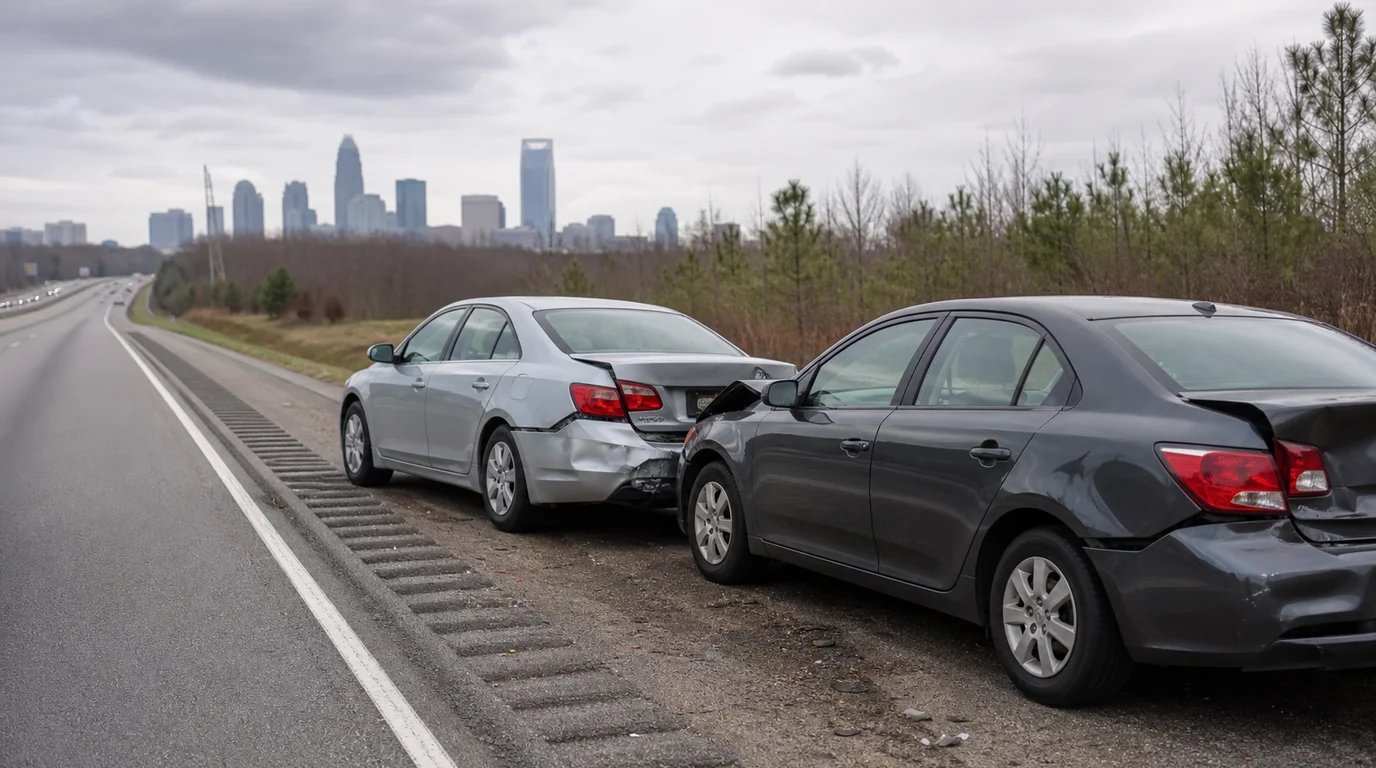

Where charlotte · rear-end collisions happen in Charlotte
Rear-end wrecks cluster in Charlotte the way the city’s traffic clusters — in predictable corridors at predictable times.
The most reliable rear-end zone in the city is I-77 through Uptown. The southbound morning rush funnels suburban commuters into a bottleneck between Brookshire Freeway (NC-16) and the John Belk Freeway. The afternoon reversal stacks northbound lanes from Tyvola Road through downtown. Lane-merging chaos in both directions produces a steady supply of low-speed rear-end impacts, especially in the segments between Trade Street and Morehead Street where lanes drop unexpectedly.
I-485 — the outer loop — produces a different kind of case. Short merge ramps, sudden slowdowns at the Independence Boulevard and Providence Road interchanges, and perennial congestion near University City, Pineville, and Matthews mean rear-end impacts at highway speeds rather than low-speed creep. Highway-speed rear-end injuries are categorically more serious than the surface-street version.
Independence Boulevard (US-74) is its own problem. A long arterial with dozens of signalized intersections and drivers shifting between 50-mph highway-feel sections and stop-light segments. The stop-and-go pattern is the rear-end ideal: a driver behind a stopping car, eyes briefly elsewhere, no time to react. Wrecks accumulate at the Wendover, Sharon Amity, and Albemarle Road intersections in particular.
Other recurring Charlotte rear-end zones: Park Road in the SouthPark area (school traffic plus retail congestion), Providence Road south of Sharon Road, Tryon Street near the LYNX Blue Line rail crossings, the I-77 / I-485 interchange at the city’s south side, and Sugar Creek Road heading east from Uptown.
The University City corridor — W.T. Harris Boulevard, I-85 approaching the University Research Park, and the NC-49 connector toward I-485 — adds a high-growth, high-volume rear-end pattern to the Charlotte caseload. Morning peaks from UNC Charlotte traffic and the Research Park employment base compound the I-485 congestion near the university interchange. Eastway Drive and the commercial corridors feeding Central Avenue carry over-loop traffic from I-277 and generate steady surface-street rear-end volume at their major intersections.
Ballantyne in south Charlotte and the NC-51 / I-485 interchange area represent a third pattern: high-income commuter suburbs with newer roads but traffic volumes that have outpaced the infrastructure. Rear-ends near Ballantyne Corporate Park and along John J. Delaney Drive accumulate during the morning and evening peaks when the I-485 outer loop in that quadrant hits capacity. The nature of the vehicles and drivers in this corridor does not change the legal analysis, but it does affect how adjusters value injuries when comparable-income plaintiffs are involved.
Medical care and the Mecklenburg County court
Charlotte rear-end victims who require ambulance transport typically end up at one of two destinations: Atrium Health Carolinas Medical Center in Dilworth — the region’s only Level I trauma center — for severe injuries, or Novant Health Presbyterian Medical Center for serious-but-not-critical cases. The two systems’ records read differently in defense lawyers’ hands; familiarity with how each documents soft-tissue injuries and orthopedic findings shapes the case work-up.
If the wreck happened within Mecklenburg County, your case will most likely be filed in Mecklenburg County Superior Court for matters above $25,000 in controversy, or District Court for smaller claims. Mecklenburg’s civil docket is one of the most active in the Carolinas. Settlement before filing remains the rule rather than the exception, but cases that must be tried can run 12–24 months from filing to resolution at the current pace.
If the wreck happened south of the NC-SC line, the case becomes a York County, SC matter under SC law — meaningfully different from a Mecklenburg case in both fault rules and procedure.
How NC law applies to your Charlotte case
North Carolina is one of only four states (along with Alabama, Maryland, and Virginia) that still applies pure contributory negligence. The rule is harsh and Mecklenburg County’s insurance-defense bar knows it well: if a Charlotte jury finds you even 1% responsible for the wreck, the at-fault driver’s insurer argues you recover nothing.
That argument shows up routinely in rear-end cases, even ones that look airtight. Were you on your phone? Was your brake light functioning? Did you stop more abruptly than the driver behind you should have anticipated? Were your tires worn? Was the lane line faded where you were stopped? In a Charlotte case, anticipating each of these threads and dismantling them before they gain footing is half the work.
For the full Carolina legal framework — including the MIST defense, recorded-statement traps, IME-doctor tactics, UM/UIM coverage analysis, the last-clear-chance doctrine, and the eggshell-plaintiff rule — see the parent guide: Carolina Car & Rear-End Accident Attorney.
Insider perspective on Charlotte cases
What I learned from the defense side about how Mecklenburg County rear-end claims actually move: the early file value is set by a script, not by analysis. An adjuster with a stack of eighty open files isn’t investigating your case — they’re running it through a routine that produces a settlement target driven mostly by property damage and the first medical bill they see. The same script gets applied whether you’re a SouthPark professional with a herniated cervical disc or a delivery driver with a wage loss they haven’t calculated. The opening offer is structurally low because the file structurally hasn’t been worked.
The leverage point in Charlotte is to skip past that opening volley. A demand built around documented future medical care, a clean earnings-loss calculation, a state-law liability rebuttal that doesn’t leave room for the contributory-negligence wedge, and a credible signal that filing in Mecklenburg County Superior Court is on the table — that pulls the case off the script desk and onto someone with authority to negotiate something realistic.
Charlotte — common questions
How long does a Charlotte rear-end case typically take?
When liability is clear and medical treatment plateaus quickly, settlement is usually reached within 6–12 months. Cases requiring litigation in Mecklenburg County Superior Court routinely run 12–24 months from filing to resolution at the current docket pace.
I’m a Mecklenburg resident but was rear-ended in South Carolina — where does the case go?
Wrecks south of the NC-SC line are SC matters. South Carolina’s modified-comparative-negligence rules apply (recovery permitted if you are 50% or less at fault, reduced by your share), and the case would typically be filed in York County Court of Common Pleas. The legal math is more forgiving than NC’s; the investigation work is similar in shape.
Will I have to give a recorded statement to anyone after a Charlotte wreck?
Not to the other driver’s insurer under any circumstances before talking to a lawyer — their friendly questions are designed to put fault on you. Some interaction with your own carrier is usually required, but even that should be carefully framed, particularly before UM/UIM benefits are open.
I was rear-ended by an Uber or Lyft driver on I-77 in Charlotte — how is that case different?
Rideshare rear-ends have a layered insurance structure. Uber and Lyft maintain $1 million commercial liability policies when a driver is carrying a passenger or en-route to a pickup (periods 2 and 3); when the app is on but no ride accepted (period 1), coverage is $50,000/$100,000 per incident plus the driver’s personal auto policy. A seriously injured third-party vehicle occupant may have access to commercial policy limits, but the trigger analysis has to be done correctly from day one.
The driver who rear-ended me has minimum liability coverage — can I still recover for serious injuries?
Often yes, through your own UIM (underinsured motorist) coverage. NC’s UIM rules let you stack your own carrier’s coverage on top of the at-fault driver’s limits when those limits are inadequate. Stacking across household policies, umbrella coverage, and the specific policy language all affect the analysis. The early case work includes mapping every coverage source so the full recovery picture is known before the demand is structured.
For the full Carolina legal framework
This page covers the local context of Charlotte cases. For the comprehensive Carolina legal framework, see the parent guide. See the parent guide.
cases in nearby Carolina cities
Tell me what happened in Charlotte.
A free, confidential consultation. No fee unless we win.
Request a consultation 704-741-9399General information about Carolina personal-injury practice; not legal advice. Every case turns on its facts. Reading this page does not create an attorney–client relationship.