
Rock Hill rear-end accident attorney — where SC law gives you a more forgiving fault rule.
Rock Hill sits just over the South Carolina line, but the legal landscape your rear-end case lands in is meaningfully different from Charlotte’s. SC’s modified-comparative-negligence rule gives injured drivers room that NC’s pure-contributory rule does not. Cases file in York County’s Court of Common Pleas, not in Charlotte’s Superior Court. The same set of carriers operates across both states, but their tactics adapt to each state’s law. I represent Rock Hill rear-end victims personally, licensed in both NC and SC, applying a former insurance-defense attorney’s knowledge of how the carriers work cross-border files.
No fee unless we win · Personally handled by the attorney · Licensed in NC & SC
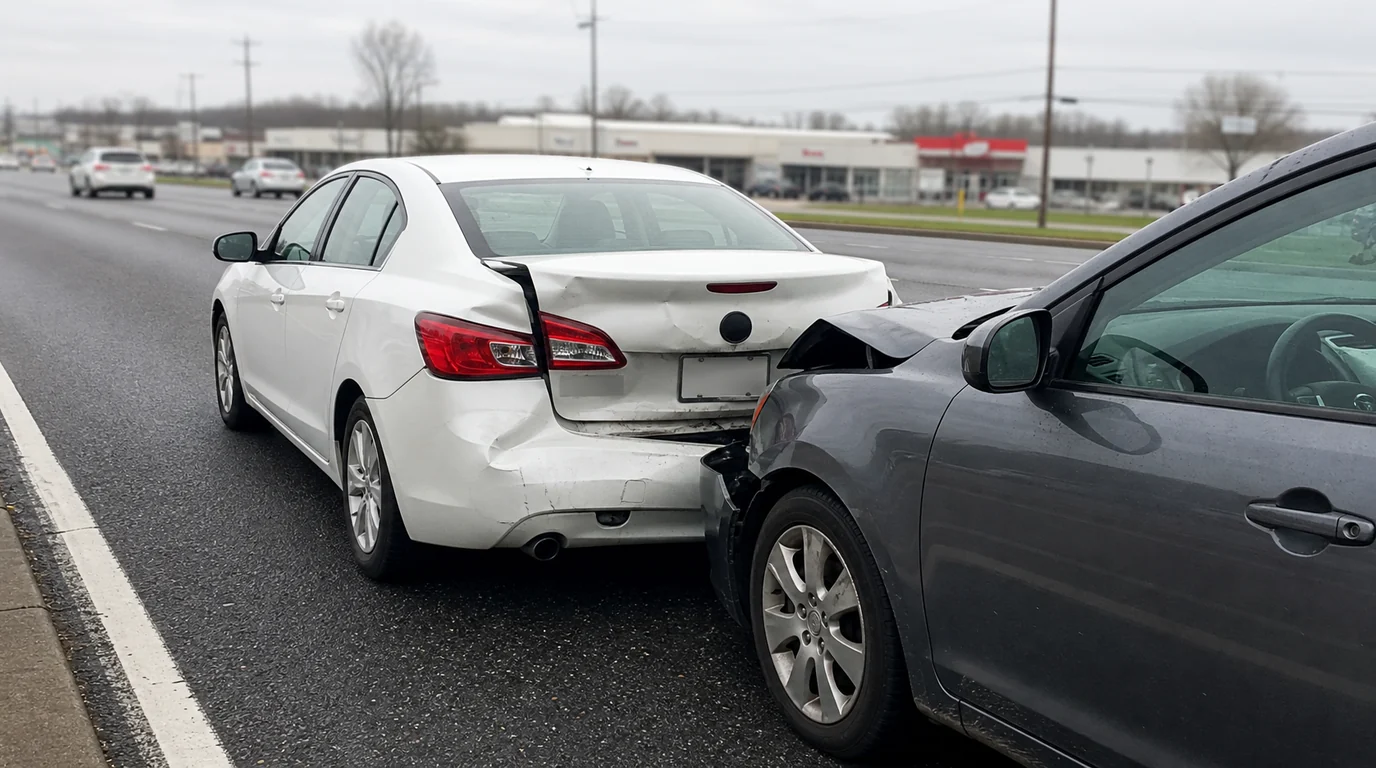

Where rock hill, sc · rear-end collisions happen in Rock Hill
Rock Hill’s rear-end patterns are dominated by one corridor that didn’t exist in its current form a generation ago: I-77, the commuter pipeline between Rock Hill and Charlotte. Tens of thousands of York County residents commute north into Mecklenburg each morning and reverse each evening; the resulting traffic produces a daily, predictable rear-end yield. The segments between the SC-NC state line and exit 79 (Celanese Road), and between Celanese Road and exit 75 (Cherry Road), are the most active. Both segments routinely back up well into Mecklenburg County in the morning northbound rush and the evening southbound reversal — which means a wreck that started on I-77 in Rock Hill sometimes spreads onto the same corridor a few miles north under different legal law (NC).
US-21 (Cherry Road) through Rock Hill is the second major corridor. The arterial connects downtown Rock Hill to the I-77 interchange and carries heavy local and commuter traffic. Rear-end wrecks accumulate at the major signalized intersections — Mt. Gallant Road, Heckle Boulevard, India Hook Road — with the classic surface-street stop-and-go pattern.
Dave Lyle Boulevard running east-west across Rock Hill is the city’s third corridor. Connecting the residential west side to the retail and university east side, Dave Lyle carries enough volume that rear-end wrecks at its major intersections (Anderson Road, Eden Terrace, Riverview Road) are routine.
Other recurring Rock Hill rear-end zones: Heckle Boulevard (US-321), India Hook Road, and the corridor along Anderson Road heading toward I-77 exit 77. Each carries enough traffic to produce recurring rear-end claims.
Medical care and the York County court
Rock Hill rear-end victims who need hospital care typically go to Piedmont Medical Center, the regional hospital that serves both Rock Hill and the surrounding York County communities (including Fort Mill, Tega Cay, and Clover). Piedmont’s ED handles the standard rear-end-injury presentations and produces medical records that South Carolina adjusters and defense counsel are familiar with. For catastrophic injuries, transport is sometimes diverted across the state line to Atrium Health Carolinas Medical Center in Charlotte for Level I trauma care — which creates an unusual medical-record pattern across two states for the same case.
Civil cases file in York County Court of Common Pleas. South Carolina’s civil procedure differs from North Carolina’s in several ways — including discovery rules, pleading requirements, and the structure of the punitive-damages analysis — that change how a Rock Hill case is built compared to a Mecklenburg one.
How SC law applies to your Rock Hill case
South Carolina applies modified comparative negligence with a 51% bar (sometimes called the “50% rule”): you can recover damages if your share of fault is 50% or less, with the award reduced by your percentage of fault. A Rock Hill rear-end case where you’re found 20% at fault yields 80% of the case value; the same case where you’re found 51% at fault yields nothing.
That math is meaningfully more forgiving than NC’s 1% bar. It changes the defense playbook. In a Rock Hill case, the defense doesn’t need to attach any fault to you to win; it needs to push your share above 50%. That’s a higher threshold and a different kind of argument — usually built around specific factual claims (speed, lookout, attention) rather than the threadpiece-fault approach used in NC. Both sides take comparative-negligence cases more seriously to trial because the percentage assignment is the case’s actual fight.
SC’s statute of limitations on personal-injury claims is three years from the date of the wreck (S.C. Code § 15-3-530), matching NC’s. Punitive damages in SC follow S.C. Code § 15-32-530, with cap exemptions for impaired-driver and certain aggravating-conduct cases.
For the full Carolina car-accident framework, including the SC modified-comparative-negligence analysis in more depth, see the parent guide: Carolina Car & Rear-End Accident Attorney.
Insider perspective on Rock Hill cases
Cross-border cases are the Rock Hill specialty. A York County resident rear-ended on I-77 in Mecklenburg County is in an NC case under contributory-negligence rules — with their own SC auto insurance policy responding for UM/UIM coverage. A Mecklenburg resident rear-ended on I-77 in York County is in an SC case under comparative-negligence rules — with their NC policy in play. The same families and the same vehicles regularly straddle both legal regimes. Determining which state’s law applies, which carriers respond, and how the coverages stack is one of the recurring questions in this practice area, and it has to be answered correctly before anything else gets done.
The other Rock Hill dynamic: SC’s more plaintiff-friendly comparative-negligence rule produces meaningfully higher settlement averages than NC cases with otherwise identical facts. Carriers sometimes try to forum-shop — pushing venue across state lines — to capture the harsher NC framework. Vigilance on venue is part of the case work.
Rock Hill — common questions
I live in Rock Hill but was rear-ended in Charlotte. Which state’s law applies?
North Carolina’s, generally — the wreck location controls the substantive law. So a Rock Hill resident hit on I-77 in Mecklenburg County is in an NC case under contributory-negligence rules, even though their auto insurance is an SC policy. Your own SC policy’s UM/UIM coverages still apply.
What’s the practical difference between SC’s 51% bar and NC’s 1% bar?
Huge. In SC, if you’re found 30% at fault, you still recover 70% of the case value. In NC, if you’re found 1% at fault, the insurer argues you recover nothing. That math changes both negotiating leverage and trial outcomes. SC cases with comparable facts tend to settle for meaningfully more.
Is York County’s civil court different from Mecklenburg County’s?
Yes — different rules of civil procedure (SC has its own), different pleading requirements, different discovery timelines, different jury pools. The case build looks similar in shape but with state-specific procedural differences that matter. Being licensed in both states matters for cross-border families.
For the full Carolina legal framework
This page covers the local context of Rock Hill cases. For the comprehensive Carolina legal framework, see the parent guide. See the parent guide.
cases in nearby Carolina cities
Tell me what happened in Rock Hill.
A free, confidential consultation. No fee unless we win.
Request a consultation 704-741-9399General information about Carolina personal-injury practice; not legal advice. Every case turns on its facts. Reading this page does not create an attorney–client relationship.