
Fort Mill pedestrian accident attorney — for northern York County crosswalk and roadside victims.
Fort Mill is South Carolina’s fastest-growing exurb of Charlotte — and its pedestrian-crash exposure has grown along with it. New subdivisions, new schools, new commercial development, and a road network that hasn’t kept up. The cases I see in Fort Mill split into two camps: catastrophic crashes on the older arterials (US-21, SC-160) and lower-speed-but-still-serious crashes in the new neighborhoods where sidewalks end mid-block and crosswalks are an afterthought. SC’s comparative-negligence rule shapes how each is evaluated.
No fee unless we win · Personally handled by the attorney · Licensed in NC & SC
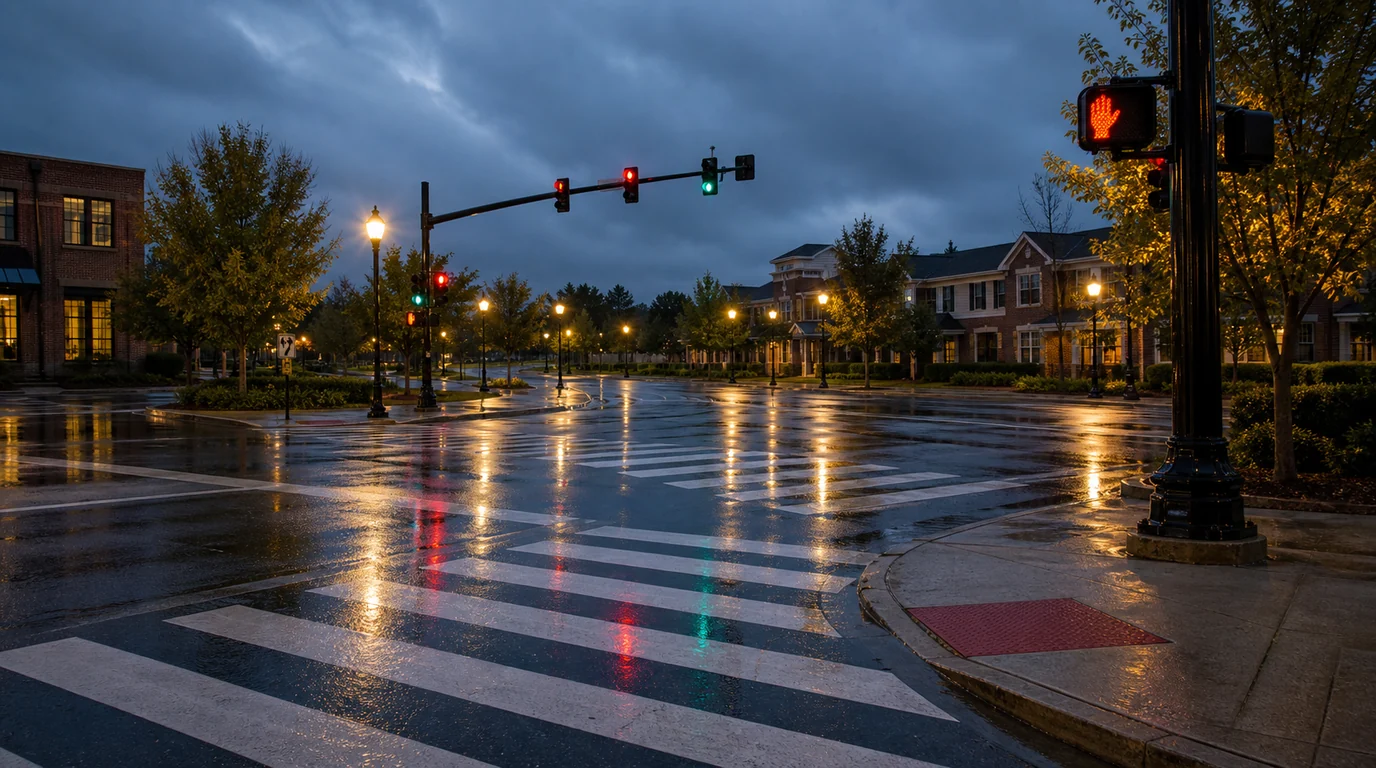

Where Fort Mill pedestrian crashes happen
The US-21 corridor running from the NC line south through Fort Mill is the most pedestrian-dangerous road in northern York County. Four-lane divided arterial, posted at 45–55 but driven faster, heavy commuter traffic from Charlotte to the SC suburbs. Crash clusters concentrate at the commercial-driveway gaps and at the interchanges where US-21 meets SC-160 and Gold Hill Road.
SC-160 (Tom Hall Street / Gold Hill Road) carries the bulk of Fort Mill’s east-west commuter traffic and is increasingly lined with commercial development — producing the parking-lot-and-entrance-driveway crash pattern. The Baxter Village area, the SC-160 commercial nodes, and the approach to I-77 generate steady pedestrian-crash volume.
The Tega Cay corridor — Tega Cay Drive, Stonecrest, and the Lake Wylie waterfront access roads — produces a different pattern: lower-speed crashes tied to lake recreation, residential walking, and weekend traffic spikes. UM/UIM coverage matters here because hit-and-run rates on lake weekends run higher than the area baseline.
The downtown Fort Mill historic core — Main Street, the blocks around the Anne Springs Close Greenway access — has intentional pedestrian infrastructure and produces lower-speed cases with strong liability profiles. The crash volume here is lower per capita than on the arterials, but the cases that do happen often turn entirely on driver fault.
Trauma care and the York County court
Severe Fort Mill pedestrian crashes route to Piedmont Medical Center in Rock Hill for initial trauma stabilization. The most severe cases transfer north to Atrium Health Carolinas Medical Center in Charlotte for Level I trauma care — a shorter and more frequently used transfer than the Charleston transfer for southern York County cases. The Piedmont–Atrium CMC pathway is well-documented in the records.
Civil cases file in York County Court of Common Pleas. The Fort Mill end of the county has its own caseload character — high-growth-exurb juries that are accustomed to seeing road-safety issues tied to development pressure. The combination usually plays favorably for plaintiffs in well-prepared cases.
How South Carolina pedestrian law shapes a Fort Mill case
SC law applies. The pedestrian framework rests on S.C. Code Title 56 for right-of-way, and the recovery framework rests on modified comparative negligence under the 51% rule: a pedestrian up to 50% at fault still recovers, with damages reduced by the fault percentage. That doctrine is the principal recovery advantage of being hit in Fort Mill rather than across the state line in Pineville or Ballantyne.
Fort Mill cases benefit from SCDOT’s corridor-safety data for US-21 and SC-160 specifically — both corridors have appeared in SCDOT crash-frequency reports tied to the growth pressure. That documentation supports the “reasonable driver should have anticipated pedestrians” analysis.
SC’s UM/UIM stacking rules are pedestrian-friendly in many configurations — particularly when household auto policies are layered on residential-renter or homeowner policies for pedestrians who don’t own a car. The first-week coverage analysis often expands the recovery beyond what the obvious policy alone provides.
Insider perspective on Fort Mill cases
The Fort Mill defense playbook has one local-pressure refinement worth noting: defense counsel sometimes argues that pedestrians in Fort Mill should expect the higher speeds and the less-developed pedestrian infrastructure — treating the exurb’s growth-pattern road design as a kind of assumed risk. That argument fails in SC for the same reason most assumed-risk arguments fail in modern tort law, but it has to be addressed directly with engineering evidence showing the road’s known dangerousness, SCDOT’s acknowledged need for improvements, and the foreseeability of pedestrian movement on roads serving residential subdivisions.
Fort Mill — common questions
I was hit crossing US-21 outside a crosswalk in Fort Mill. Will SC’s comparative-negligence rule help me?
Almost always yes. As long as your fault share is 50% or less — which is realistic in most cases where the driver was speeding, distracted, or impaired — you recover. The recovery is reduced by your fault percentage, but it is recovery, not a bar. A near-identical case just over the state line in NC might be a complete loss on contributory negligence.
The driver fled the scene at a Tega Cay intersection on a weekend. How do I get paid?
SC’s UM coverage on your auto policy (or any household policy) responds to pedestrian hit-and-run claims. Stacking rules sometimes expand the coverage substantially. We open the UM claim immediately and treat the case as if the at-fault driver were identified.
My child was hit walking to a Fort Mill school. Who’s liable beyond the driver?
The driver primarily. Depending on facts, the school district’s walking-route policy, the developer’s subdivision-design decisions, or SCDOT’s corridor management may add defendants. SC’s sovereign-immunity rules limit some governmental defendants but not all. We evaluate each potential defendant in the first 60 days.
For the full Carolina legal framework
This page covers the local geography of pedestrian crashes in Fort Mill, Tega Cay, and the rest of northern York County. South Carolina’s modified comparative-negligence rule applies, which is more pedestrian-friendly than NC’s contributory-negligence regime. For the comprehensive Carolina pedestrian-injury legal framework and the full 15 FAQs — Carolina Pedestrian Accident Attorney.
Pedestrian cases in nearby Carolina cities
Tell me what happened in Fort Mill.
A free, confidential consultation. No fee unless we win.
Request a consultation 704-741-9399General information about Carolina personal-injury practice; not legal advice. Every case turns on its facts. Reading this page does not create an attorney–client relationship.