
Rock Hill pedestrian accident attorney — for York County crosswalk and roadside victims.
Rock Hill pedestrian cases live in a different legal universe from their cousins across the state line. South Carolina applies modified comparative negligence: a pedestrian who is up to 50% at fault for the crash can still recover, with damages reduced by that fault percentage. In Charlotte, the same crash might be barred entirely on contributory negligence. That single doctrinal difference reshapes the case strategy from the first call. I am admitted in both Carolinas and handle Rock Hill cases under SC law on their merits.
No fee unless we win · Personally handled by the attorney · Licensed in NC & SC
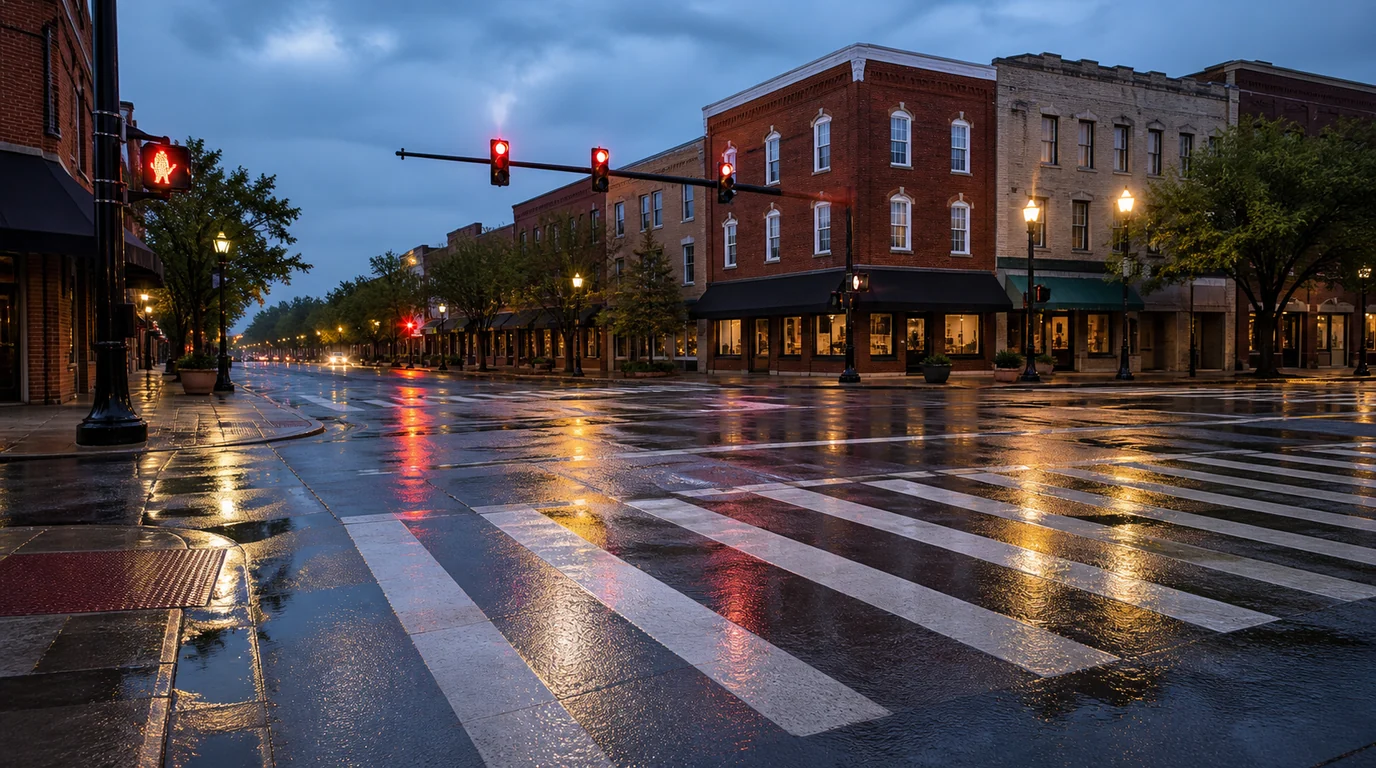

Where Rock Hill pedestrian crashes happen
Rock Hill’s pedestrian-crash corridors are well-documented. The Cherry Road corridor (US-21 Business) running the length of the city is the most heavily traveled and the most pedestrian-fatal — four lanes, posted at 35–45, lined with commercial frontage and bus stops. The Anderson Road, Albright Road, and India Hook Road corridors carry the next highest crash volume.
The Winthrop University area — Oakland Avenue, Eden Terrace, and the residential streets around the campus — produces a recurring student-pedestrian crash pattern, particularly at night and on weekends. Student-pedestrian cases in SC benefit from the comparative-negligence rule when there is any alcohol or distraction component.
The downtown Rock Hill core — Main Street, the historic district, the new Knowledge Park development — has improved pedestrian infrastructure and produces lower-speed crashes with strong liability profiles. Riverwalk and the new mixed-use developments along the Catawba have added pedestrian volume; the crash data has followed.
The I-77 frontage roads and Celanese Road corridor running toward Fort Mill produce a steady stream of suburban pedestrian crashes — new-subdivision entrances, sidewalk gaps, and the kind of road design that hasn’t kept pace with the growth.
Trauma care and the York County court
Severe Rock Hill pedestrian crashes route to Piedmont Medical Center in Rock Hill for initial trauma stabilization. The most severe cases transfer to Atrium Health Carolinas Medical Center in Charlotte or to MUSC in Charleston for Level I trauma care, depending on the case profile. Piedmont’s records system documents the transfer cleanly when one occurs.
Civil cases file in York County Court of Common Pleas. SC procedure differs from NC’s in several material ways — including the affidavit-of-merit requirements in some case types, different discovery rules, and different statute-of-limitations applications. The case has to be worked as a South Carolina case from day one.
How South Carolina pedestrian law shapes a Rock Hill case
SC’s pedestrian framework is structured around S.C. Code Title 56 for right-of-way rules. Like NC, drivers must yield to pedestrians in marked crosswalks and at unmarked crosswalks at intersections. Like NC, pedestrians crossing outside crosswalks generally must yield to vehicles. Unlike NC, however, SC applies modified comparative negligence under the 51% rule: as long as the pedestrian’s share of fault is 50% or less, recovery is permitted, with damages reduced by the fault percentage.
That doctrinal difference is decisive in cases where a pedestrian crossed outside a crosswalk but the driver was clearly speeding, distracted, or impaired. In NC, contributory negligence would likely bar the case; in SC, the comparative-negligence rule produces a recovery proportional to driver fault. Many cases that are unwinnable in NC are winnable in SC, and the venue analysis is part of every cross-border crash evaluation.
SC also applies its own UM/UIM stacking rules, which differ from NC’s in important particulars. The first conversation in a Rock Hill case always covers the SC-specific recovery vehicles, including the SC Department of Insurance’s handling of UIM disputes.
Insider perspective on Rock Hill cases
Defense counsel in SC pedestrian cases sometimes tries to introduce NC-style contributory-negligence framing — particularly when the defense attorney also practices in NC and is more comfortable with that doctrine. The response is to pin down the comparative-negligence standard early in jury instructions and to keep the case anchored in SC law. The other recurring SC-specific move is the early policy-limits push: SC carriers sometimes offer limits early in catastrophic pedestrian cases to extinguish the UIM claim. Evaluating whether the limits offer fairly accounts for the comparative-negligence reduction is core case work; sometimes it does, sometimes it doesn’t.
Rock Hill — common questions
I was hit crossing Cherry Road outside a crosswalk. Can I still recover under SC law?
Almost certainly yes — if the driver was speeding, distracted, or impaired. SC’s 51% comparative-negligence rule means you can recover as long as your fault share is 50% or less. The recovery is reduced by your fault percentage, but it is recovery rather than a complete bar. A near-identical case across the line in Charlotte might be unwinnable on contributory negligence.
My case crosses the NC/SC line — I was hit just inside SC on a road that crosses into NC. Which law applies?
SC law applies if the crash occurred in SC, regardless of where the driver and pedestrian live. The choice-of-law analysis is location-of-the-tort. We evaluate every cross-border case for venue advantages early because the comparative-vs-contributory difference is often the case itself.
Does SC’s UM/UIM coverage work the same as NC’s for hit-and-run pedestrians?
Similar but not identical. SC permits UM recovery for pedestrian hit-and-run victims under most household auto policies. Stacking rules differ; the policy language has to be read carefully. We evaluate the SC-specific coverage in the first week.
For the full Carolina legal framework
This page covers the local geography of pedestrian crashes in Rock Hill and across York County, South Carolina. South Carolina pedestrian law differs materially from North Carolina’s — modified comparative negligence rather than the contributory-negligence trap. For the comprehensive Carolina pedestrian-injury legal framework and the full 15 FAQs — Carolina Pedestrian Accident Attorney.
Pedestrian cases in nearby Carolina cities
Tell me what happened in Rock Hill.
A free, confidential consultation. No fee unless we win.
Request a consultation 704-741-9399General information about Carolina personal-injury practice; not legal advice. Every case turns on its facts. Reading this page does not create an attorney–client relationship.