
Shelby pedestrian accident attorney — for Cleveland County crosswalk and roadside victims.
Shelby’s pedestrian-crash pattern is the smaller-Carolinas-town pattern: a downtown core that works for pedestrians, an old residential grid with sidewalk continuity issues, and a handful of dangerous arterials carrying through-traffic to and from the I-85 corridor. The cases that come into my office break cleanly between downtown/residential crashes (lower speeds, stronger liability) and the US-74 / NC-150 arterial crashes that produce the more catastrophic injuries.
No fee unless we win · Personally handled by the attorney · Licensed in NC & SC

Where Shelby pedestrian crashes happen
US-74 (Dixon Boulevard) and NC-150 running through and around Shelby are the dominant high-speed pedestrian-crash corridors. US-74 carries the through-traffic between Charlotte and the western Carolinas; NC-150 carries the cross-county traffic and the truck movement tied to the regional industrial base. Posted at 45–55, often driven faster, with intermittent signalized crossings and sidewalk gaps.
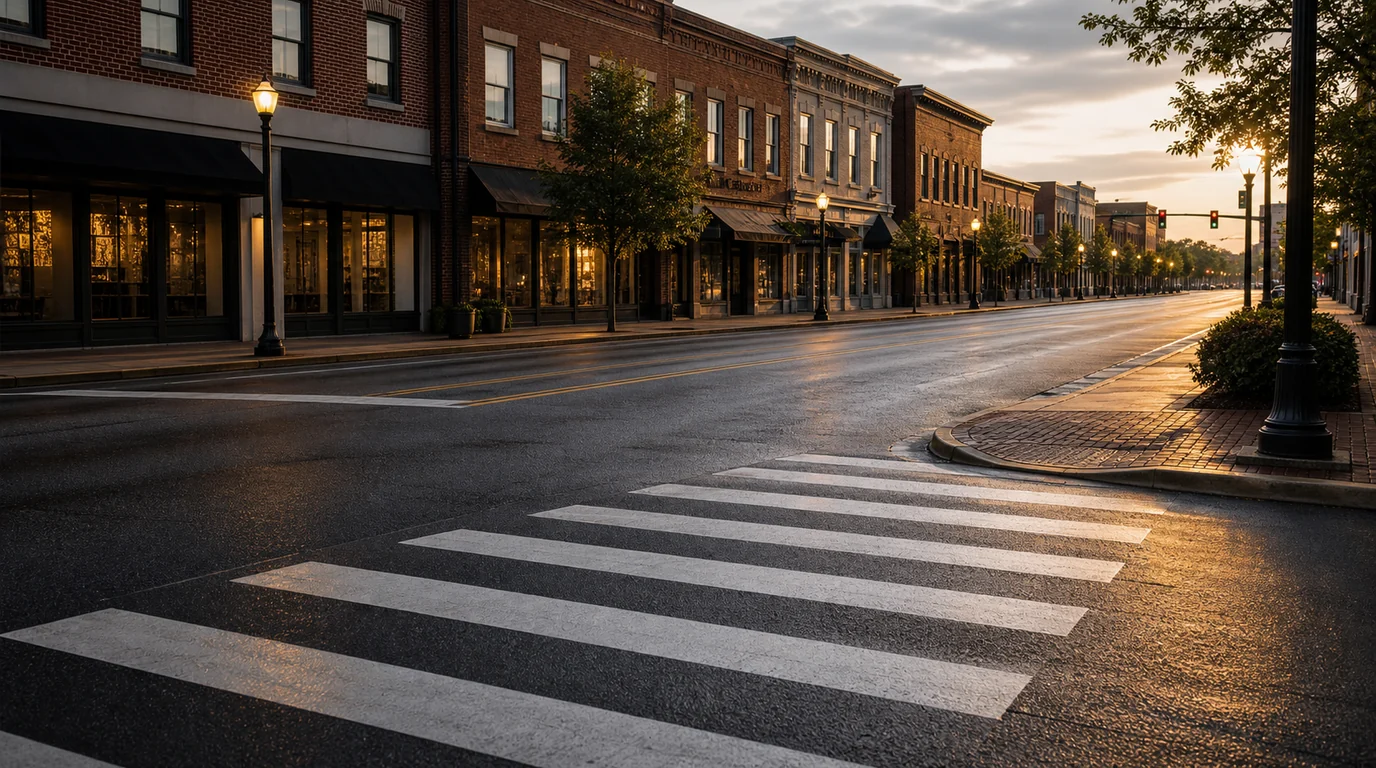
The downtown Shelby historic core — Lafayette Street, Marion Street, the blocks around the Earl Scruggs Center and the historic courthouse — produces lower-speed cases with strong liability profiles. The downtown streetscape supports pedestrian foreseeability; crashes here usually turn on driver-side evidence.
The Cleveland Community College area and the older residential grids produce a steady stream of local-driver / local-pedestrian cases. Sidewalk continuity issues, aging signal infrastructure, and bus-stop placement drive the pattern. These are typically smaller policy-limit cases but often involve clear-liability factual patterns.
The Cleveland County Fair, Earl Scruggs Center events, and seasonal festivals produce event-day pedestrian-crash spikes — out-of-area drivers, unfamiliar road geometry, and crowd-related visibility issues. The cases sometimes implicate commercial defendants (shuttle services, event-related transportation operations).
Trauma care and the Cleveland County court
Severe Shelby pedestrian crashes route to Atrium Health Cleveland for initial trauma stabilization. The most severe cases transfer to Atrium Health Carolinas Medical Center in Charlotte for Level I trauma care — the I-85 / US-74 corridor makes this a workable transfer. Atrium Cleveland’s records system documents the transfer cleanly.
Civil cases file in Cleveland County Superior Court in Shelby. Cleveland County’s docket moves at a reasonable pace; jurors here are accustomed to the small-town crash patterns and respond well to thorough liability presentations and well-documented damages.
How North Carolina pedestrian law shapes a Shelby case
NC’s framework applies: §§ 20-173, 20-174, contributory negligence, last clear chance. The Shelby twist is the relative absence of complicating commercial-vehicle issues outside the US-74 corridor, which can make Cleveland County cases more straightforward to evaluate than cases in Mecklenburg or Iredell. The flip side is that policy limits in Cleveland County cases tend to be lower than in larger Carolinas markets — the UM/UIM coverage analysis matters disproportionately.
US-74 appears on NCDOT’s high-crash corridor reports for the section running through Cleveland County. The documented pattern rebuts the “could not anticipate” defense and supports the negligence theory.
Event-day cases sometimes implicate governmental and event-organizer defendants when the event’s traffic management was inadequate. NC’s sovereign-immunity rules limit some governmental claims but not all; the analysis has to be done case-by-case.
Insider perspective on Shelby cases
The Cleveland County defense playbook is less aggressive than what defense counsel runs in Mecklenburg or Iredell, but it still has the standard NC moves: the early recorded-statement push, the contributory-negligence framing, the early limits offer. The Shelby-specific addition is the quick policy-limits offer in clear-liability cases involving local defendants, designed to extinguish UIM claims that might otherwise stack across household policies. The response is to slow the policy-limits decision until the UM/UIM map is complete — sometimes there are stackable layers in the household coverage that materially expand the recovery.
Shelby — common questions
I was hit on US-74 in Shelby. Are these cases winnable?
Yes, with the right evidence work. US-74 is on NCDOT’s documented high-crash corridor list for the Cleveland County section. That documentation rebuts the “could not anticipate” defense. The contributory-negligence argument has to be addressed head-on with engineering evidence, but it is generally not fatal in cases where the driver was speeding, distracted, or impaired.
My case happened during the Cleveland County Fair or an Earl Scruggs Center event. Different case?
Sometimes. Event-day crashes often involve out-of-area drivers and may implicate event-organizer or shuttle-service defendants. The traffic-management plan for the event becomes relevant evidence. We evaluate whether commercial or governmental defendants apply in the first 60 days.
The driver who hit me had only minimum coverage. Am I limited to that?
Often not. Underinsured-motorist coverage on your auto policy (or any household policy) stacks on top of the at-fault driver’s limits when your damages exceed those limits. NC’s stacking rules can expand the recovery substantially across multiple household vehicles in some configurations.
For the full Carolina legal framework
This page covers the local geography of pedestrian crashes in Shelby and across Cleveland County. For the comprehensive Carolina pedestrian-injury legal framework — statutes, contributory negligence, last clear chance, hit-and-run recovery, and the full 15 FAQs — Carolina Pedestrian Accident Attorney.
Pedestrian cases in nearby Carolina cities
Tell me what happened in Shelby.
A free, confidential consultation. No fee unless we win.
Request a consultation 704-741-9399General information about Carolina personal-injury practice; not legal advice. Every case turns on its facts. Reading this page does not create an attorney–client relationship.