
Fort Mill construction accident attorney — for northern York County tradespeople hurt on the job.
Fort Mill has been one of the fastest-growing construction markets in the entire Carolinas region. Subdivisions, schools, commercial growth, the LPL Financial corporate campus, the explosive Kingsley / Springfield / Bridge Street build-out — all of it has driven a steady construction-injury caseload that runs under SC’s legal framework. SC’s modified comparative-negligence rule is materially more favorable to injured workers than NC’s contributory-negligence trap.
No fee unless we win · Personally handled by the attorney · Licensed in NC & SC
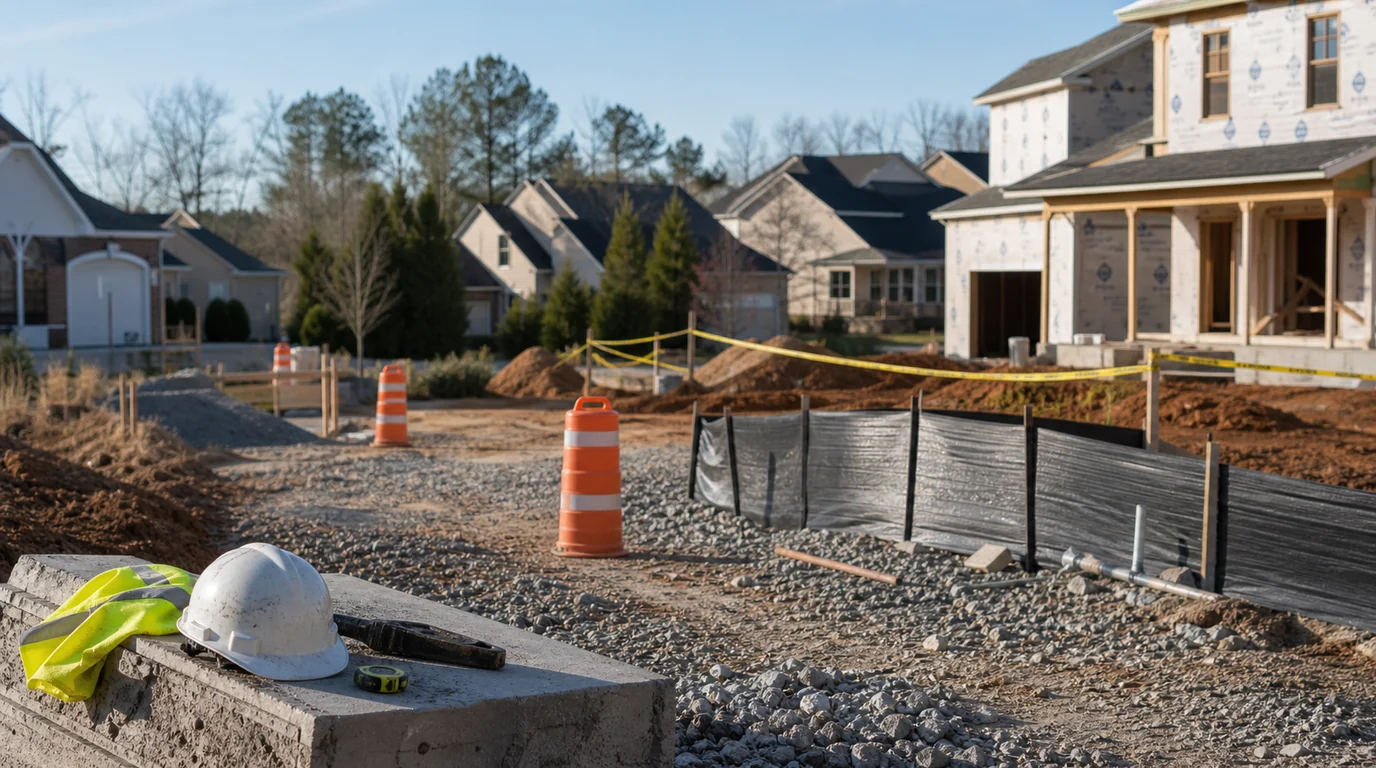

Where Fort Mill construction injuries happen
The Kingsley / Springfield / Bridge Street and broader Fort Mill mixed-use developments have produced sustained construction activity over the past five-plus years. The injury fact patterns are typical of large mixed-use builds: high-rise and mid-rise residential construction injuries, parking-deck construction injuries, retail and restaurant tenant-fit-out injuries, and the recurring multi-contractor coordination issues that accompany large projects.
The LPL Financial corporate campus and other corporate-headquarters construction in the Fort Mill area drove a meaningful share of recent commercial-construction injury cases. Large institutional projects typically carry deep CGL and excess coverage layers, expanding the recovery ceiling in third-party cases.
The residential subdivision build-out across northern York County, Indian Land, and the Tega Cay peninsula has been continuous. Framing, roofing, mechanical-trades, and excavation injuries dominate the caseload. SC’s comparative-negligence rule changes how worker-conduct defenses are evaluated.
The I-77 logistics and commercial corridor through Fort Mill produces warehouse, distribution, and commercial-construction injury cases tied to the growth. Multi-contractor projects with deep coverage layers are typical.
School construction (Fort Mill School District has been the fastest-growing in SC) adds an institutional-construction case category with its own coverage characteristics.
Medical care and the York County workers’-comp/court overlap
Severe Fort Mill construction injuries route to Piedmont Medical Center in Rock Hill for initial trauma care, with transfer to Atrium Health Carolinas Medical Center in Charlotte for the most severe cases — a shorter transfer than the Charleston pathway. Trauma, orthopedic, and rehabilitation records are central to both tracks of the case.
Comp cases run through the SC Workers’ Compensation Commission; civil third-party cases file in York County Court of Common Pleas. The two tracks run in parallel under SC procedure.
How South Carolina law shapes a Fort Mill construction case
SC’s Workers’ Compensation Act under Title 42 applies. The third-party negligence track runs under SC’s modified comparative-negligence rule — a 51% bar that allows recovery as long as the worker’s fault share is 50% or less, with damages reduced by the percentage. Compared to NC’s contributory-negligence framework, the comparative rule produces meaningful recovery in cases that would lose entirely just over the state line.
The Fort Mill construction market’s heavy multi-contractor coordination produces classic third-party defendant ladder cases: GC, multiple specialty subs, equipment manufacturers, property owners, sometimes anchor tenants. Identifying each potential defendant in the case’s first 30–60 days is decisive for the recovery picture.
SC’s product-liability framework for equipment-defect cases is workable; the recovery ceiling on machinery-defect cases is high. SC’s comp-lien framework on third-party recoveries differs from NC’s and has to be worked under SC rules.
Insider perspective on Fort Mill cases
Fort Mill construction-injury cases share Rock Hill’s cross-border practice complication: defense counsel sometimes brings NC framing into SC cases. The strategic work is to keep the case under SC substantive law and SC procedure, particularly at jury-charge time. The Fort Mill-specific feature is the fast-growth dynamic — defense counsel sometimes pushes for early settlement before the plaintiff side has identified every potential third-party defendant from the multi-contractor ladder typical of large local projects. The response is patience and thorough early defendant identification.
Fort Mill — common questions
Multi-contractor Fort Mill project — who’s responsible?
Often several parties. SC law allows third-party claims against every non-employer party whose conduct contributed. GCs, specialty subs, equipment manufacturers, owners, and sometimes anchor-tenant defendants all show up in the same case. Identifying every potential defendant in the first 30–60 days affects the recovery ceiling materially.
I was hurt on a Fort Mill subdivision build — the comp carrier denied my claim because the framing crew was “independent contractor.” Now what?
SC has its own tests for employee status under the comp framework — right of control, integration, and other factors regardless of how the parties labeled the relationship. Sometimes the comp claim is recoverable despite the carrier’s initial denial. Even when comp doesn’t apply, the third-party negligence case against the GC and other non-employer parties typically does.
My case crosses the NC/SC line. Which state’s law applies?
Generally the law of the state where the injury occurred. SC law is meaningfully more favorable to plaintiffs in many configurations because of comparative negligence and SC-specific procedural rules. We evaluate every cross-border case for venue and choice-of-law advantages.
For the full Carolina legal framework
This page covers the local context of construction-site injuries in Fort Mill, Tega Cay, and northern York County. SC’s workers’-comp and comparative-negligence rules apply — meaningfully different from NC’s. For the comprehensive Carolina framework and the full 15 FAQs — Carolina Construction Accident Attorney.
Construction-injury cases in nearby Carolina cities
Tell me what happened in Fort Mill.
A free, confidential consultation. No fee unless we win.
Request a consultation 704-741-9399General information about Carolina personal-injury practice; not legal advice. Every case turns on its facts. Reading this page does not create an attorney–client relationship.