
Monroe pedestrian accident attorney — for Union County crosswalk and roadside victims.
Monroe’s pedestrian-crash exposure runs along one dominant axis: US-74, the four-lane highway that splits the city and carries the truck and commuter traffic between Charlotte and the eastern Carolinas. Pedestrian cases in Monroe cluster on US-74 and the secondary corridors that cross it, with a smaller but recurring set of cases tied to the downtown core and the new residential growth on the city’s western edge. Each pattern has its own defense playbook and its own evidence strategy.
No fee unless we win · Personally handled by the attorney · Licensed in NC & SC

Where Monroe pedestrian crashes happen
US-74 (Roosevelt Boulevard / Independence Boulevard through Monroe) is the single most dangerous pedestrian corridor in Union County. Wide, fast, heavily trafficked by commercial vehicles, and lined with commercial driveways and bus stops, it produces the lion’s share of Monroe’s severe pedestrian crashes. The interchange areas with NC-200 (Skyway Drive) and Old Monroe-Marshville Road see particularly heavy crash volume.
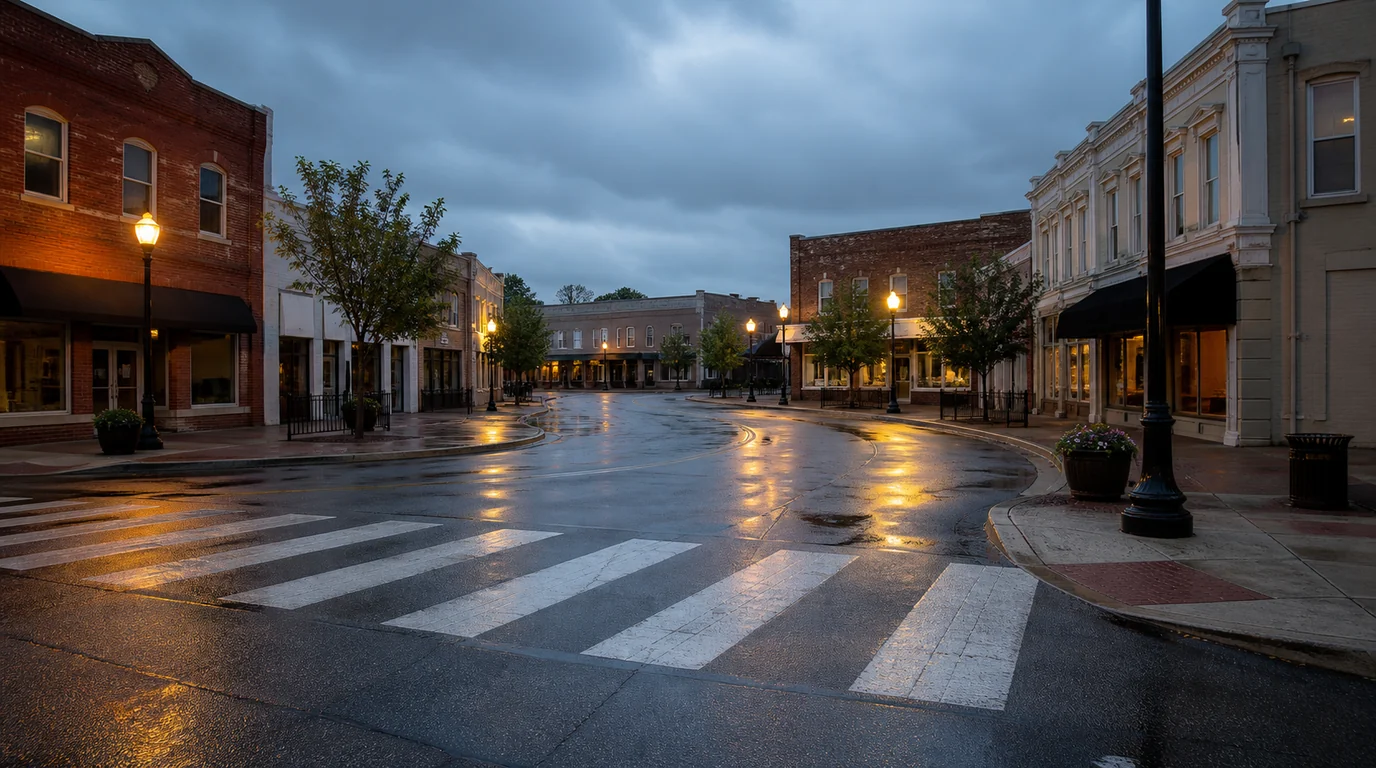
The downtown Monroe square and surrounding blocks produce lower-speed crashes with higher recovery profiles. Marked crosswalks, signalized intersections, and documented signal timing make the cases turn on driver-side evidence (distraction, impairment, speed) rather than pedestrian behavior. The historic-district streetscape supports the “reasonable driver should have anticipated pedestrians” analysis.
The Highway 75 / Stallings Road corridor running west toward Indian Trail and Stallings produces a steady stream of suburban pedestrian crashes — sidewalk gaps, new-development entrances, and bus stops placed for vehicle convenience rather than pedestrian safety. The cases here often involve out-of-county defendants commuting between Mecklenburg and Union counties.
The industrial and agricultural-employer corridors south and east of the city produce overnight shift-worker crashes — pedestrians walking to or from poultry processing, manufacturing, and ag operations in low-light rural conditions. Workers’-compensation overlap is common in these cases.
Trauma care and the Union County court
Severe Monroe pedestrian crashes route to Atrium Health Union in Monroe for initial trauma stabilization; the most severe cases transfer to Atrium Health Carolinas Medical Center in Charlotte for Level I trauma care. The Atrium Union–Atrium CMC transfer pathway is well-established and documented, which helps the records side of the case.
Civil cases file in Union County Superior Court. Union County’s docket is steady but not as backed up as Mecklenburg’s; cases tend to reach settings within 12–18 months when they don’t settle. Local representation matters — Union jurors respond to lawyers who know the corridors and the towns within the county.
How North Carolina pedestrian law shapes a Monroe case
The NC framework applies: §§ 20-173, 20-174 for right-of-way, contributory negligence for any pedestrian fault, last clear chance as the principal workaround. The Monroe twist is the predominance of commercial-vehicle defendants on US-74 — freight trucks, delivery vehicles, commercial fleets running the Charlotte-to-east-Carolina route. Commercial-vehicle cases bring federal motor-carrier regulations into play, which expands the duty owed and the evidence available (electronic logging device data, dispatch records, maintenance logs).
Workers’-compensation overlap is more common in Union County pedestrian cases than in many other counties because of the agricultural and industrial employer base. Coordinating the comp claim with the third-party case is standard.
The US-74 corridor through Monroe appears repeatedly on NCDOT’s high-crash corridor reports for pedestrian incidents. That documented pattern rebuts the “could not anticipate” defense and supports negligence per se in some signal-violation cases.
Insider perspective on Monroe cases
The Union County defense playbook leans on two specific moves. First, defense counsel routinely pushes early settlement in commercial-vehicle cases — before the plaintiff side has obtained the electronic logging device data, dispatch records, and driver-history files. The first 60 days are about preserving and obtaining that evidence before any settlement conversation. Second, in agricultural-worker cases, defense counsel sometimes tries to characterize the case as a workers’-compensation matter only, walling off the larger third-party recovery. The response is to coordinate but not collapse: comp pays its part; the third-party negligence case proceeds in parallel for the rest of the damages.
Monroe — common questions
I was hit by a commercial truck on US-74 in Monroe. What evidence matters most early?
The truck’s electronic logging device data, the carrier’s dispatch records, the driver’s hours-of-service logs, and any onboard camera footage. Commercial carriers are required to preserve much of this under federal regulations, but only if a preservation letter is sent quickly. We send that letter within days of being retained.
I was a third-shift worker walking home from a poultry plant when I was hit. Comp or lawsuit?
Often both. Workers’ comp may apply if the employer required or controlled the route. The separate third-party negligence claim against the at-fault driver covers the damages comp doesn’t reach (pain and suffering, full lost wages, future earning capacity). The two are coordinated; the comp carrier asserts a lien on the third-party recovery.
The driver fled the scene on US-74 at night. How do I get paid?
Uninsured-motorist coverage on your auto policy (or any household policy) is the recovery vehicle. NC permits stacking across household vehicles in some configurations, which can materially expand the recovery. We open the UM claim immediately and treat the case as if the at-fault driver were identified.
For the full Carolina legal framework
This page covers the local geography of pedestrian crashes in Monroe and across Union County. For the comprehensive Carolina pedestrian-injury legal framework — statutes, contributory negligence, last clear chance, hit-and-run recovery, and the full 15 FAQs — Carolina Pedestrian Accident Attorney.
Pedestrian cases in nearby Carolina cities
Tell me what happened in Monroe.
A free, confidential consultation. No fee unless we win.
Request a consultation 704-741-9399General information about Carolina personal-injury practice; not legal advice. Every case turns on its facts. Reading this page does not create an attorney–client relationship.