
Fort Mill rear-end accident attorney — on the Charlotte commuter corridor.
Fort Mill has grown from a small mill town to one of the highest-income suburban communities in South Carolina, largely on the strength of its proximity to Charlotte. The result: a small geographic footprint carrying outsize commuter traffic across two states. If you were rear-ended on I-77 anywhere between Carowinds and the Rock Hill line, on SC-160 (Gold Hill Road), or on US-21, you’re in an SC case — with the more forgiving modified-comparative fault rule that comes with it — but the carrier handling the file is often the same one that handles Charlotte cases under NC’s contributory rule. I represent Fort Mill rear-end victims personally, licensed in both states and working a former insurance-defense attorney’s knowledge of the carriers’ playbook.
No fee unless we win · Personally handled by the attorney · Licensed in NC & SC
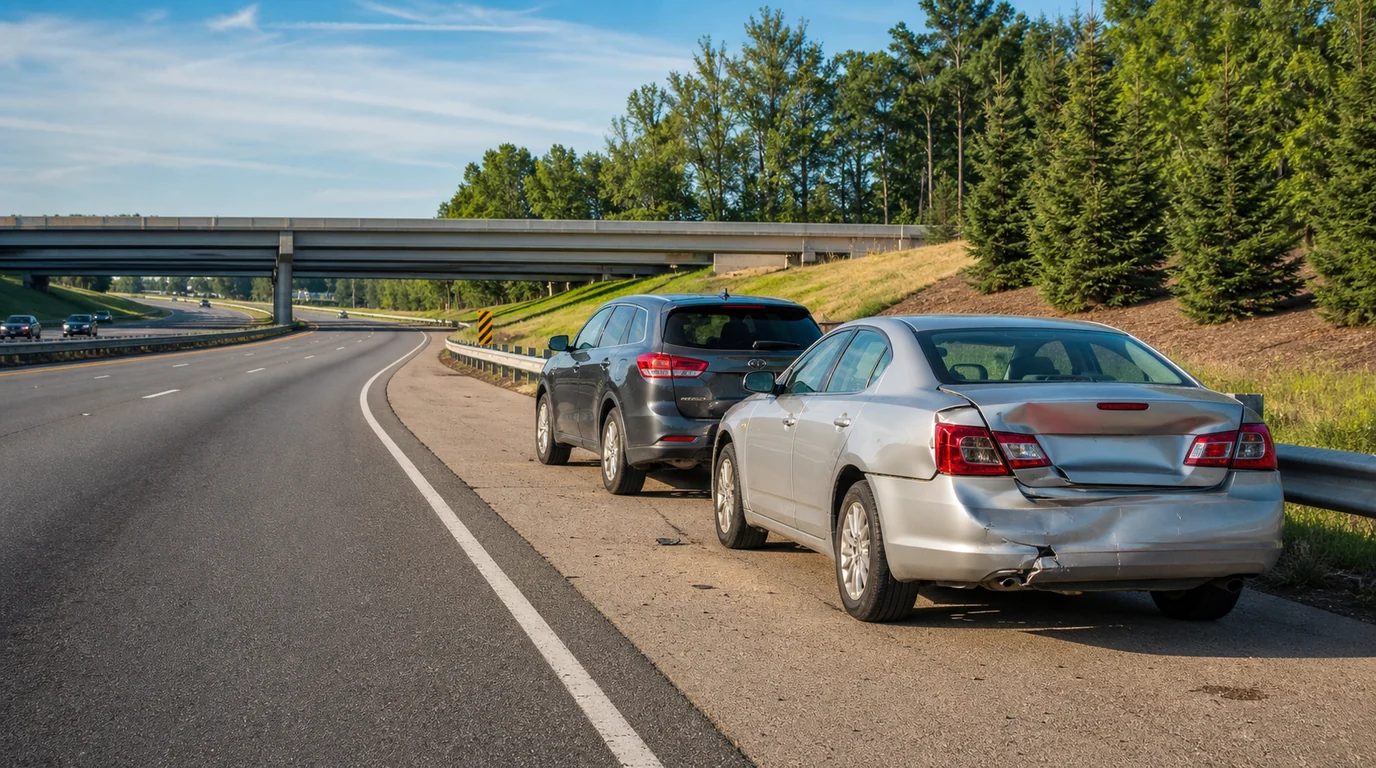

Where fort mill, sc · rear-end collisions happen in Fort Mill
Fort Mill’s rear-end patterns are concentrated on three corridors that absorb the city’s commuter and growth traffic.
I-77 is the dominant rear-end zone in Fort Mill. The interstate carries the morning commuter flow into Charlotte and the evening reversal; volumes between exit 88 (Carowinds Boulevard) and the SC-NC state line consistently rival Mecklenburg County’s most congested stretches. The Carowinds exit creates predictable Saturday and event-weekend rear-ends; the Sutton Road and SC-160 interchanges create morning-rush rear-ends from drivers slowing for the slow lanes ahead. Highway-speed rear-end impacts on this segment produce meaningfully more serious injuries than the surface-street version.
SC-160 (Gold Hill Road) running east-west through Fort Mill is the city’s second corridor. The Gold Hill Road corridor has grown faster than its design accommodates — from a rural connector to a heavily-trafficked arterial with growing commercial density. Signalized intersections at US-21, Pleasant Road, and Springfield Parkway are recurring rear-end sites. The stop-and-go pattern through the corridor’s commercial sections produces a steady volume of mid-speed rear-end cases.
US-21 through Fort Mill (Tom Hall Street through downtown and continuing north toward the state line) is the third corridor. Connecting Rock Hill to Pineville and Charlotte’s south side, US-21 carries enough commuter volume to produce recurring rear-end wrecks at its major intersections — particularly at Gold Hill Road, Spratt Street, and the I-77 connectors.
Other recurring Fort Mill rear-end zones: Pleasant Road through the residential west side, SC-160 / Steele Road further east, and the Carowinds Boulevard / I-77 ramp system on event weekends.
Medical care and the York County court
Fort Mill rear-end victims who need hospital care typically go to Piedmont Medical Center in Rock Hill, which serves the Fort Mill area as the nearest full-service hospital. Catastrophic injuries are sometimes diverted across the NC line to Atrium Health Carolinas Medical Center in Charlotte for Level I trauma services — producing the same cross-state medical-record pattern that complicates Rock Hill cases.
Civil cases file in York County Court of Common Pleas, the same court that handles Rock Hill cases. York County’s civil docket runs at a moderate pace, faster than Mecklenburg’s; the SC procedural rules differ from NC’s in ways that affect both timeline and case structure.
How SC law applies to your Fort Mill case
South Carolina’s modified-comparative-negligence rule (51% bar) applies in Fort Mill cases the same way it does in Rock Hill cases. The recovery math is more forgiving than NC’s: a Fort Mill resident found 30% at fault recovers 70% of damages, where the same finding in Charlotte would defeat the entire claim.
Fort Mill’s commuter demographics produce a recurring legal question: many Fort Mill residents are NC employees working in Charlotte, with their primary daily mileage on I-77. When their rear-end wreck happens north of the state line, they’re in an NC case under harsh contributory rules; south of the line, they’re in an SC case under more forgiving rules. The same case sequence with the same parties can produce a different recovery outcome based on which side of an arbitrary geographic line the impact happened on. Determining venue precisely is the first investigation step.
For the comprehensive Carolina car-accident framework, see the parent guide: Carolina Car & Rear-End Accident Attorney.
Insider perspective on Fort Mill cases
Fort Mill’s demographic profile changes the carrier analysis. Higher-income commuter households tend to carry higher auto-insurance liability limits, more comprehensive UM/UIM coverage, and umbrella policies on top of underlying auto policies — layered coverages that often exceed what NC neighbors of similar incomes carry. On a serious Fort Mill rear-end case, the coverage hunt is often more productive than it would be on a comparable Mecklenburg case. The starting question isn’t “is there enough coverage” — it’s “where is all the coverage and how does it stack.”
The flip side: defense carriers know Fort Mill cases tend to involve higher-value injuries (more comprehensive medical care, more expensive lost-earnings calculations, more sophisticated plaintiffs) and they bring more experienced defense counsel to the file earlier. The case build has to match that level of opposition.
Fort Mill — common questions
I live in Fort Mill but work in Charlotte — what coverage do I have?
Your own SC auto policy responds to wrecks on either side of the state line for UM/UIM coverage. If a household-relative has separate coverage (a spouse on a separate policy, an adult child), those policies often stack. Many Fort Mill families also carry umbrella coverage that extends UM/UIM substantially. We review every policy on every case — the coverage hunt is often the case’s biggest single driver of value.
My rear-end happened at Carowinds traffic — is that case different?
Carowinds-event-weekend traffic produces a measurable spike in I-77 rear-ends in Fort Mill. Many of those cases involve out-of-state visitors (different home-state insurance), rental cars (rental-coverage analysis), or rideshare drivers (commercial-policy layered). The coverage analysis is more complex than a typical Fort Mill commuter rear-end.
How does York County’s court handle SC rear-end cases vs. Mecklenburg’s NC rear-end cases?
Different rules of civil procedure, different pleading standards, different discovery timelines, different jury characteristics. The case strategy adapts to each forum. Cross-border-licensed counsel matters because the same case sequence with the same parties produces meaningfully different work product depending on which side of the line the wreck happened.
For the full Carolina legal framework
This page covers the local context of Fort Mill cases. For the comprehensive Carolina legal framework, see the parent guide. See the parent guide.
cases in nearby Carolina cities
Tell me what happened in Fort Mill.
A free, confidential consultation. No fee unless we win.
Request a consultation 704-741-9399General information about Carolina personal-injury practice; not legal advice. Every case turns on its facts. Reading this page does not create an attorney–client relationship.